

AI is quietly automating the compliance work that once filled HR consultants’ days. The question isn’t whether to adapt — it’s what to do with the time and capacity that’s being freed up.
The Quiet Disruption Nobody’s Talking About
Something is shifting beneath the surface of HR consulting. It isn’t dramatic — there’s no single announcement, no flashpoint moment. But it is relentless.
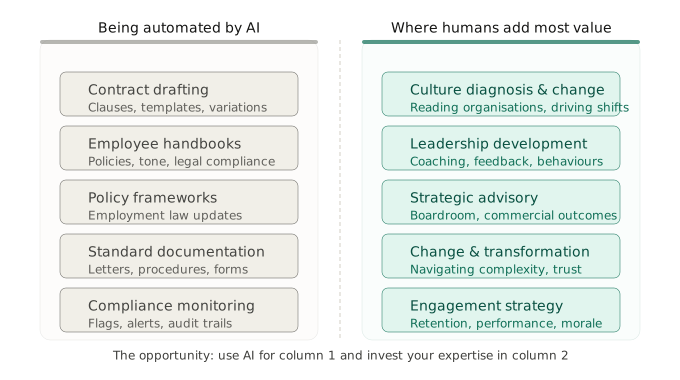
AI tools are getting very good at the compliance-heavy, documentation-intensive work that has long been the bread and butter of outsourced HR: drafting contracts, updating employee handbooks, building policy frameworks, keeping pace with employment law changes. Work that once required hours of a consultant’s time can increasingly be turned around in minutes.
For HR consultants and outsourced HR providers, this creates an uncomfortable truth: a significant portion of current revenue is built on work that is becoming commoditised. The clients who once paid for it will soon expect it to come faster, cheaper, or bundled in.
The Untapped Lever: Organisational Culture
Of all the levers available to HR consultants looking to demonstrate genuine business impact, organisational culture remains the most underutilised. Not because it isn’t important — most senior leaders will readily acknowledge it is — but because it has historically been difficult to pin down, measure, and act upon in a way that resonates with a commercially-minded board.
Culture gets discussed in terms of “values” and “ways of working.” It surfaces during engagement surveys, exit interviews, and the occasional team away-day. But it rarely gets treated as what it actually is: a direct driver of commercial performance.
That is exactly what needs to change.
The Culture → Performance Causation Chain
The linkage between culture and business results isn’t abstract — it’s a clear, traceable chain of cause and effect. Understanding it is what separates consultants who talk about culture from those who get paid to transform it.
01 |
Leadership Behaviours
The behaviours modelled at the top set the tone for everything that follows. Values only become real when leaders live them visibly. ⬇️ |
02 |
Workplace Culture
Those behaviours shape the unwritten rules of how things actually get done — the environment people operate in every day. ⬇️ |
03 |
Employee Experience
Culture defines whether people feel included, trusted, and purposeful — or overlooked, micromanaged, and disengaged. ⬇️ |
04 |
Employee Engagement
Experience drives discretionary effort, retention, and advocacy. Engaged employees go further; disengaged ones cost far more than their salary. ⬇️ |
05 |
Customer Experience
How employees feel about their work shows up directly in how they serve customers — quality, responsiveness, and care are all culturally mediated. ⬇️ |
06 |
Business Performance
Revenue growth, profitability, and organisational resilience are the downstream result of everything above. Culture isn’t soft — it’s structural.
|
For HR consultants, the opportunity lies in making this chain visible, measurable, and — critically — actionable. Not as a theoretical framework, but as a practical roadmap for intervention.
“Culture is no longer a ‘soft’ topic. It is a measurable, manageable driver of business success — and the consultants who can prove that will be the ones clients keep calling.”
Where Culture Consulting Currently Falls Short
Most attempts at culture work follow a familiar — and frustrating — pattern. A consultant runs an engagement survey or facilitated workshop. A report is produced. Themes are identified. And then, more often than not, the momentum stalls.
The reasons are predictable. Culture diagnostics are time-intensive to design and interpret. By the time analysis is complete and results are presented, the window for action may have narrowed. And the data itself — without clear prioritisation — can feel overwhelming rather than directing.
There are two critical failure points:
- Data generated without clear direction or priorities
- Consultant time consumed by diagnostics, not delivery
This is the insight-execution gap. And it is where the most valuable culture work gets lost. Insight exists, but transformation stalls — and client confidence erodes with it.
A Smarter Model: Diagnosis Handled, Execution Owned
The shift that forward-thinking HR consultants are making is straightforward in principle, even if it requires a change in how work is structured: outsource the diagnostic process to technology designed for it, and concentrate human expertise on what technology cannot do — building trust, designing interventions, navigating organisational dynamics, and driving sustainable change.
This is where platforms like Cultiv8tiv are changing the economics of culture consulting.
Cultiv8tiv runs the assessment process end-to-end: deploying a truly anonymous culture assessment across the organisation, gathering employee responses, and using AI to produce a clear, prioritised report that maps directly to the causation chain. The output isn’t raw data — it’s interpreted insight, structured around specific strengths, friction points, and priority areas for action.
For the consultant, this means arriving at the client conversation not with a blank canvas, but with a credible, data-grounded picture of the culture and its relationship to business performance — without having spent weeks building the survey, chasing responses, or wrestling with analysis.
From Diagnostic Tool to Revenue Pipeline
Here is where the commercial logic becomes compelling. A culture assessment, delivered this way, is not just a diagnostic — it is a scoping document for everything that comes next.
Every organisation that completes a Cultiv8tiv assessment has, in effect, produced a prioritised list of culture and performance challenges. Each of those challenges represents a natural entry point for consulting work. The data doesn’t just tell the client what’s wrong — it tells the consultant exactly where to direct their expertise.
Leadership DevelopmentWhere leadership behaviours are identified as the root cause, there is a clear mandate for coaching, 360 feedback, or structured development programmes. |
Team EffectivenessWhere collaboration, trust, or psychological safety scores flag, team-level interventions become the obvious next step. |
Change & TransformationOrganisations navigating growth, restructure, or M&A need cultural alignment work — and the assessment makes the case for it. |
Engagement StrategyWhere retention and discretionary effort are the identified pain points, a targeted engagement programme has a direct commercial rationale. |
The assessment, in this model, is the opening conversation — not the whole engagement. It creates a natural, evidence-based pathway into higher-value, longer-duration work.
The Economics Work Too
One of the persistent barriers to culture work has been cost and accessibility. Comprehensive diagnostics — traditionally built around bespoke surveys, consultant-facilitated focus groups, and manual analysis — have been expensive and time-consuming to deliver. They have often been reserved for larger clients or bundled into significant retainers.
By centralising the assessment process through Cultiv8tiv, that changes. The entry point becomes significantly more accessible — a benefit both for the client, who can engage with culture work at a lower initial investment, and for the consultant, who can offer it cost-effectively across a broader client base without sacrificing margin.
The result is the ability to scale culture consulting in a way that simply wasn’t possible before: more clients, more consistent methodology, more time available for the strategic and relational work that generates the deepest value.
Repositioning the Consultant’s Role
There is a broader professional shift at stake here, and it’s worth naming directly.
As AI handles more of the transactional and compliance-heavy work in HR, the consultants who thrive will be those who have successfully repositioned themselves as strategic partners — people whose value is measured not in the policies they produce or the hours they log, but in the business outcomes they influence.
Culture consulting, done well, is that repositioning made real. It connects HR work to commercial performance in a way that boards and CEOs understand and value. It gives clients a reason to bring their HR consultant into strategic conversations, not just operational ones.
The combination of a robust, AI-powered assessment platform and skilled human delivery is what makes this possible. Neither alone is sufficient. The data without the consultant produces reports that gather dust. The consultant without the data produces recommendations that lack the credibility to drive real change.
The Consultants Who Will Stand Out
The HR consulting landscape is consolidating around a new kind of value proposition. Compliance and documentation work, once a reliable source of billable hours, is under pressure from every direction. Clients expect more for less. Technology is delivering it.
But the demand for genuine transformation — for help building organisations that perform, retain talent, and navigate change with resilience — has never been higher. That work is complex, relational, and deeply contextual. It requires the kind of judgement, credibility, and human understanding that no AI can replicate.
The consultants who recognise this shift early — and who build their practice around measurable culture change rather than documentation compliance — will be the ones who define what great HR consulting looks like in the next decade.
Culture is the most powerful lever in the toolkit. It’s time to use it.