

Time for a re-think?
Employee engagement surveys have become one of the most common tools organisations use to understand how their people are feeling.
Every year, millions of employees are asked whether they feel motivated, recognised, supported and valued. The results are analysed, benchmarked and presented to leadership teams, often accompanied by detailed action plans.
There is nothing inherently wrong with engagement surveys.
In fact, when designed well and followed by meaningful action, they can provide valuable insight into the employee experience.
However, there is an uncomfortable truth that many organisations need to confront.
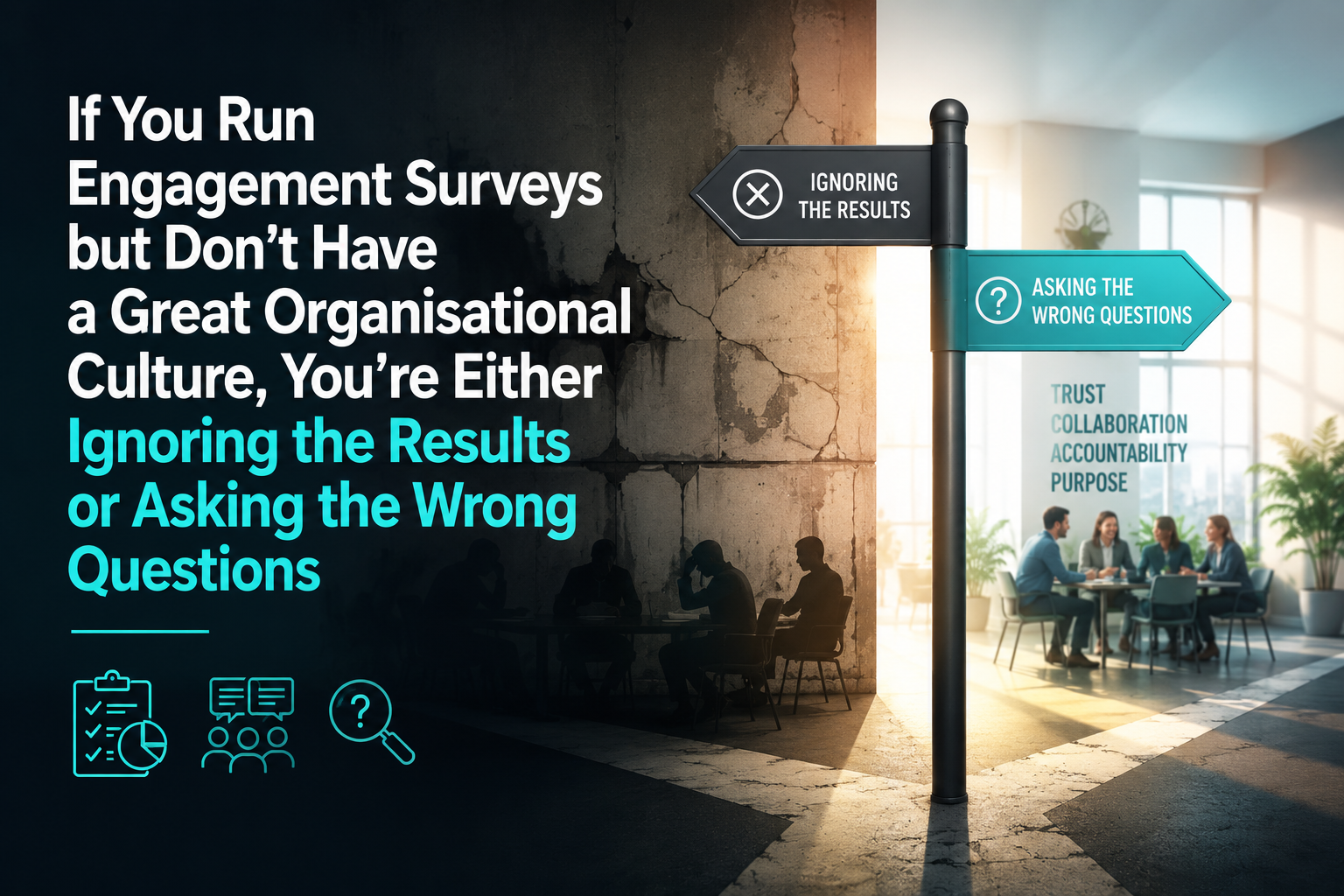
If your organisation continues to experience poor leadership, high staff turnover, low trust, inconsistent management or resistance to change despite regularly running engagement surveys, then one of two things is probably true.
Either you’re asking the wrong questions.
Or
You’re not acting on the answers.
Engagement Is an Outcome, Not the Cause
One of the biggest misconceptions in organisational development is treating engagement as though it is the thing that needs fixing.
It isn’t.
Engagement is a reflection of the environment people work in.
It is the result of leadership behaviours, management capability, trust, communication, accountability, purpose, empowerment and dozens of daily interactions that shape how work gets done.
In other words, culture creates engagement—not the other way around.
If leaders only measure how engaged employees feel, they may never uncover why employees feel that way in the first place.
It’s a little like measuring the temperature without investigating what’s causing the fever.
Are You Measuring the Right Things?
Many traditional engagement surveys focus on questions such as:
- Do you enjoy working here?
- Would you recommend this organisation?
- Do you feel recognised?
- Are you satisfied with your role?
- Would you recommend us as an employer?
These are useful questions.
But they rarely identify the underlying cultural conditions that influence organisational performance.
A stronger organisational culture assessment asks questions such as:
- Do employees trust senior leadership?
- Are managers consistent in how they lead people?
- Is accountability clear across the organisation?
- Do people feel psychologically safe to challenge decisions?
- Are organisational values visible in everyday behaviour?
- Does communication build confidence during periods of change?
- Are people empowered to make decisions?
- Do different departments collaborate effectively?
These questions don’t simply measure sentiment.
They diagnose the organisational systems and behaviours that are driving it.
At Cultiv8tiv, we believe culture should be measured across the factors that genuinely influence organisational performance, including leadership, management, trust, accountability, communication, motivation and organisational alignment. Our assessment framework evaluates twelve essential components of workplace culture to help organisations identify the root causes of both strong and weak performance.
The Cultiv8tiv difference is that we don’t only tell you if there is an issue, but also what is causing it and what you can do about it.
When the Survey Already Knows the Answer
Interestingly, the bigger issue often isn’t the survey itself.
Many engagement surveys successfully identify problems.
Employees tell leaders that communication is poor.
They report inconsistent management.
They highlight a lack of trust.
They explain why change initiatives are failing.
The report is shared.
Leadership discusses the findings.
An action plan is created.
Then business priorities take over.
Twelve months later, the same issues appear again.
Employees notice this pattern remarkably quickly.
Eventually, they stop believing their feedback will make any difference.
Response quality declines.
Honesty decreases.
Trust erodes.
The survey, originally designed to strengthen employee voice, unintentionally becomes evidence that nothing changes.
As we’ve said before, the purpose of an employee survey isn’t to collect data—it’s to connect data to action. When employees repeatedly share their experiences but see little evidence of meaningful change, the survey process itself begins to lose credibility.
The Hidden Cost of Measuring Without Acting
Collecting employee feedback creates an expectation.
Employees assume that if leadership asks for their opinion, leadership intends to listen.
More importantly, they expect leaders to respond.
When organisations fail to act, several things happen:
- Trust in leadership declines.
- Future survey responses become less honest.
- Employee participation falls.
- Change fatigue increases.
- Leaders lose visibility of the organisation’s real challenges.
Ironically, organisations often respond by introducing more surveys, more initiatives and more communication.
Yet none of these address the root cause. Employees don’t need another questionnaire.
They need evidence that their feedback matters and that when they provide things change!
Culture Is a Commercial Issue
Organisational culture is often discussed as though it belongs exclusively to HR.
It doesn’t. Culture influences almost every commercial outcome that matters.
A healthy culture improves:
- Employee retention
- Leadership effectiveness
- Productivity
- Innovation
- Customer experience
- Collaboration
- Decision-making
- Organisational agility
- Employer reputation
Ultimately, it influences business performance, growth, financial outcomes and, for many organisations, long-term enterprise value.
Investors, buyers and regulators increasingly recognise that a strong organisational culture reduces risk and improves the likelihood of sustainable growth.
That’s why leading organisations are moving beyond measuring engagement alone.
They are seeking to understand the cultural conditions that produce business performance.
The Difference Between Listening and Understanding
Listening to employees is essential.
Understanding what they’re telling you is transformational.
The organisations that make the greatest progress don’t simply collect feedback.
They identify patterns.
They understand root causes.
They prioritise meaningful change.
They communicate openly about what they’ve learned.
Most importantly, they demonstrate progress over time.
That’s how trust is built.
A Better Question for Leadership Teams
Rather than asking,
“How engaged are our employees?”
Perhaps leadership teams should begin by asking,
“Do we truly understand the culture we’ve created—and are we prepared to change it?”
Because if the same cultural issues continue to appear year after year, the challenge is unlikely to be your employees.
It’s far more likely to be one of two things.
Either you’re asking the wrong questions.
Or
You’re ignoring the answers.
Final Thought
Employee engagement surveys remain an important part of understanding the employee experience.
But engagement is only one piece of a much bigger picture.
If you want to improve performance, strengthen leadership, retain great people and increase the long-term value of your organisation, don’t just measure engagement. Measure culture.
Understand what’s driving it. Then have the courage to act on what you discover.