

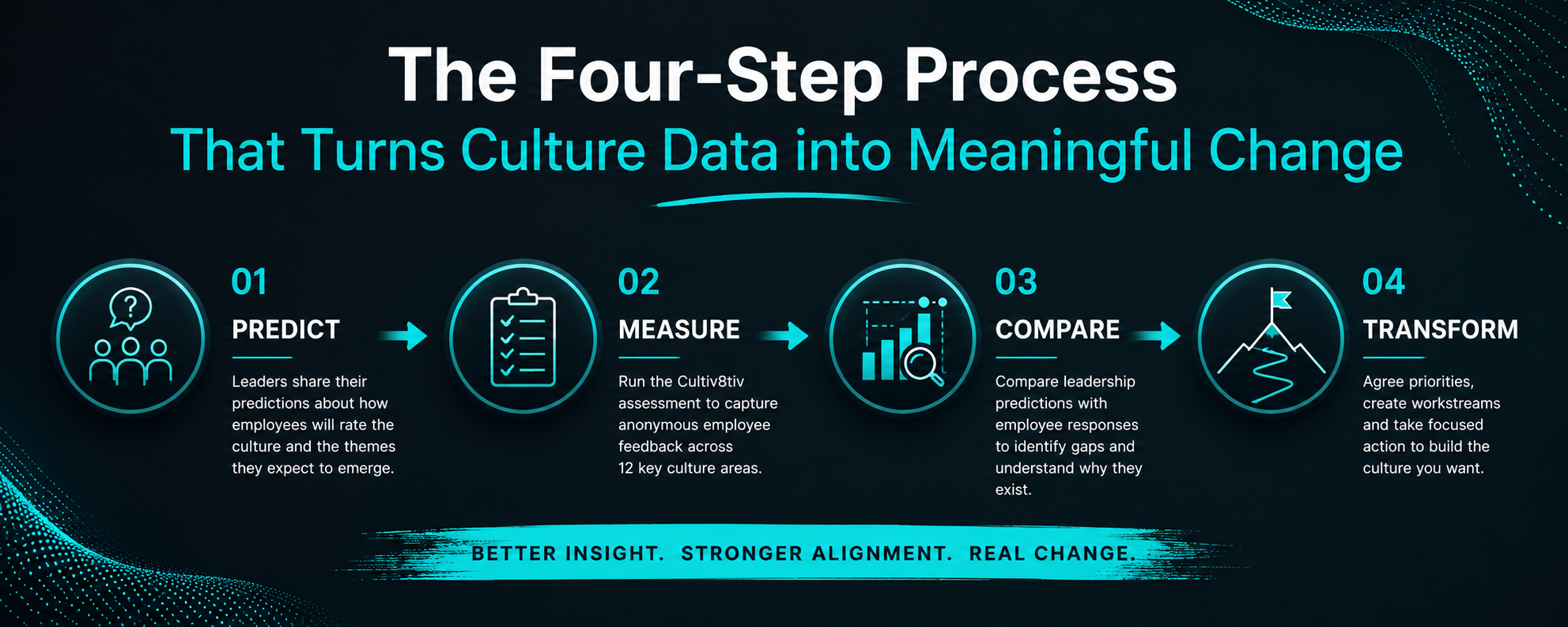
The Four-Step Process That Turns Culture Data into Meaningful Change
Most organisations don’t struggle because they fail to measure culture.
They struggle because they fail to understand the gap between what leaders believe is happening and what employees experience every day.
Traditional engagement and culture surveys provide a snapshot of employee opinion. They identify strengths, highlight areas of concern and generate valuable data.
But they rarely answer one critical question:
How well do our leaders actually understand the culture they’re leading?
At Cultiv8tiv, we believe the most valuable insight doesn’t come from the survey alone. It comes from comparing leadership expectations with employee reality, then using that insight to create a focused programme of cultural improvement.
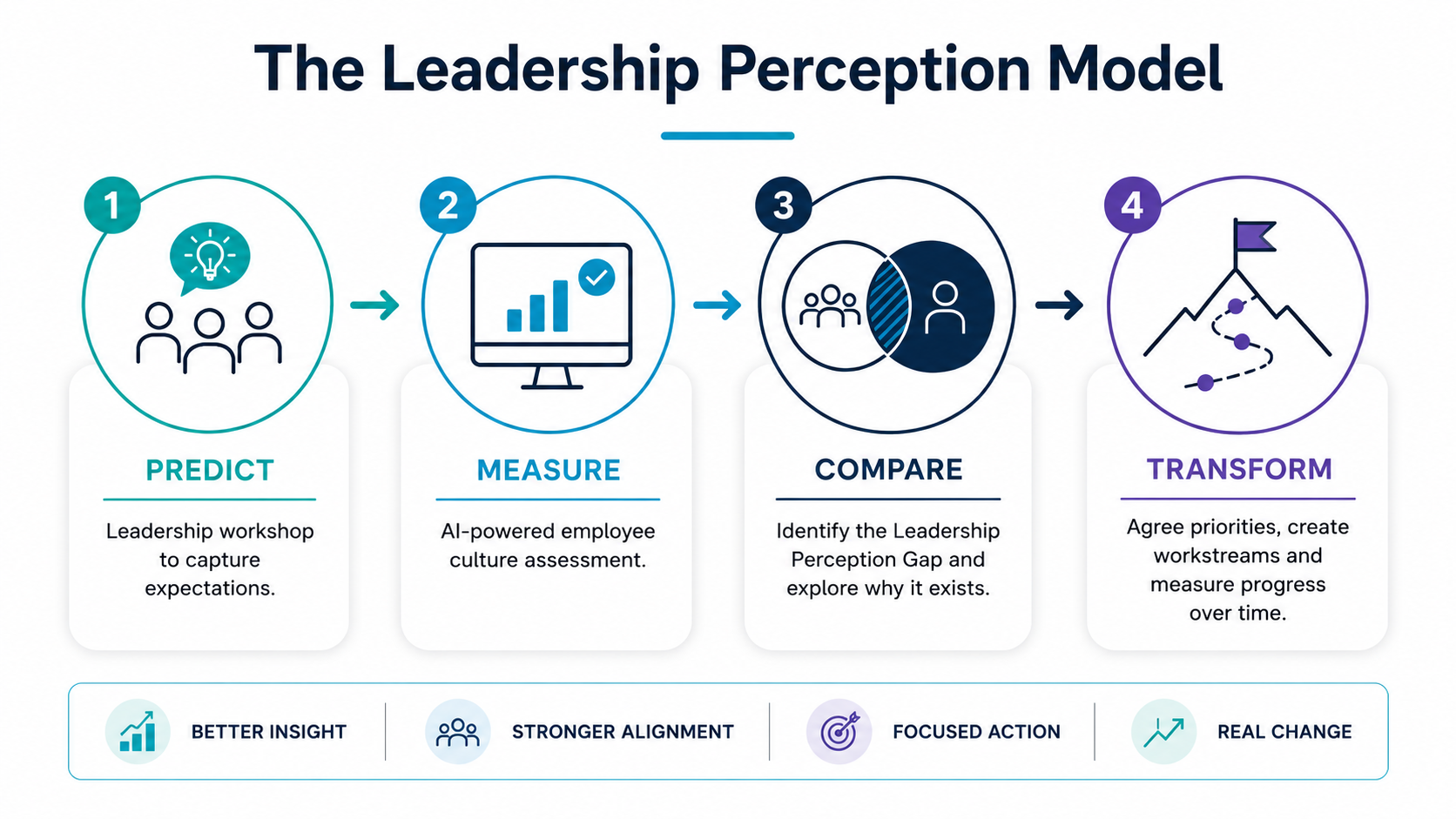
Our approach is built around four practical steps.
Step 1 – Explore Leadership Perceptions
Before a single employee completes a survey, it is important to begin with the leadership team.
Rather than asking them to complete the same assessment as everyone else, we would recommend facilitating a workshop or conducting one-to-one interviews to understand how they believe the organisation will perform.
Questions could include:
- How do you think employees will score each of the 12 dimensions of organisational culture?
- Where do you expect the organisation to perform well?
- Which areas do you believe will require improvement?
- What themes or comments do you expect to emerge?
- What concerns do you already have about the organisation’s culture?
Of course you could run through the assessment questions if you want to.
This conversation is about more than predicting scores. It reveals leadership assumptions, surfaces differing perspectives within the executive team and creates a valuable baseline against which employee feedback can later be compared.
It’s also an opportunity to align leaders around what success looks like before the evidence arrives.
Step 2 – Measure the Employee Experience
The next stage is to invite employees to complete a Cultiv8tiv organisational culture assessment.
Every response is anonymous, encouraging honest feedback and giving employees the confidence to share their genuine experiences.
The assessment explores the behaviours, beliefs and experiences that shape organisational culture across our twelve core dimensions, including leadership, trust, communication, accountability, empowerment, management and organisational purpose.
Within hours of the assessment closing, organisations receive detailed AI-powered analysis that highlights:
- Overall Culture Pulse Score
- Performance across each cultural dimension
- Key strengths
- Emerging risks
- Themes from employee comments
- Actionable recommendations
Most importantly, this provides an objective picture of the culture employees experience every day.
Step 3 – Identify the Leadership Perception Gap
This is where the real value begins. Time to compare what leaders expected employees to say with what employees actually told us.
Sometimes the two align closely. When they do, it demonstrates strong organisational awareness and suggests leaders have a realistic understanding of the employee experience.
However, the most valuable conversations often emerge where significant gaps exist. Perhaps leaders expected trust to score highly, but employees report uncertainty and inconsistency.
Maybe communication was assumed to be effective, while employees describe feeling disconnected from decision-making.
Or perhaps leaders believed accountability was embedded, yet employees feel poor performance is tolerated.
The objective isn’t to prove leadership right or wrong. It’s to understand why these differences exist. To explore questions such as:
- Why did leadership expect different results?
- What experiences are shaping employee perceptions?
- Are there inconsistencies between departments or management teams?
- What assumptions need challenging?
- Which issues represent the greatest organisational risk?
The discussion moves beyond simply reviewing scores. It focuses on understanding the story behind the data.
Step 4 – Agree Priorities and Build the Action Plan
Too many culture surveys end with the report.
That’s where the Leadership Perception process really begins.
Using the assessment findings and the insights gained from the Leadership Perception Gap analysis, coaches and consultants can facilitate a workshop with the leadership team to agree where effort should be focused.
Rather than trying to improve everything at once, leaders identify the priorities that will have the greatest impact on organisational performance and employee experience.
It is then critical to define a series of focused work streams, each with clear ownership, measurable outcomes and agreed success criteria.
These might include:
- Strengthening leadership visibility and communication.
- Building trust through greater transparency.
- Improving management capability and consistency.
- Embedding accountability across teams.
- Enhancing recognition and employee engagement.
- Clarifying organisational purpose and values.
- Developing stronger feedback and listening mechanisms.
By the end of the process, the organisation has moved from data collection to a practical roadmap for cultural improvement.
From Measurement to Momentum
Culture assessments should never be seen as an end in themselves. Their value lies in the conversations they create and the actions they inspire.
By combining leadership insight with employee experience, organisations gain a much richer understanding of their culture than either perspective could provide on its own.
They uncover hidden assumptions, identify organisational blind spots and build leadership alignment around the changes that matter most.
At Cultiv8tiv, we believe culture transformation starts with understanding. Not just understanding how employees feel. But understanding how accurately leaders understand the organisation they lead.
When leadership perception and employee experience begin to align, organisations are in a far stronger position to build cultures that attract talent, improve performance and deliver sustainable long-term success.