

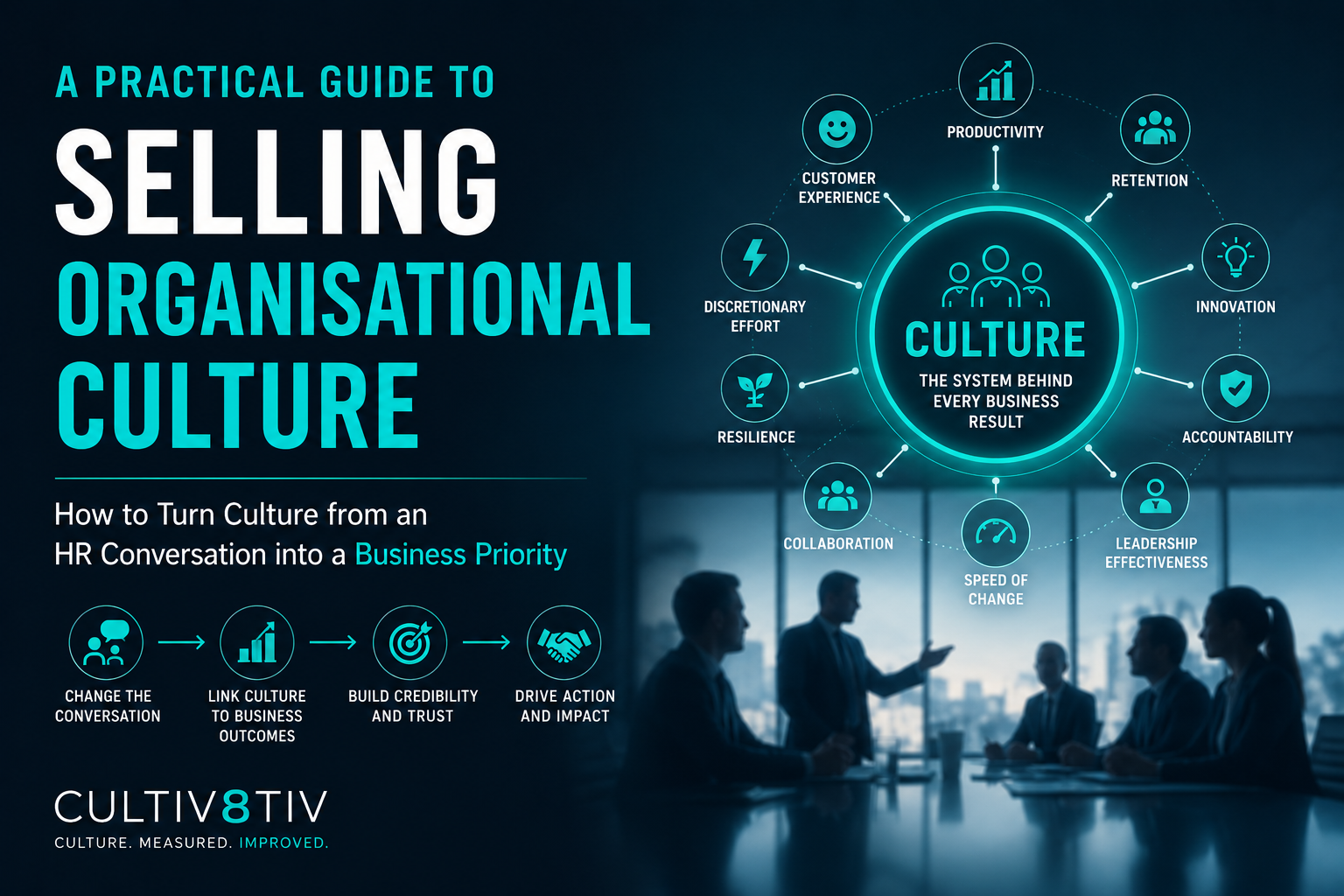
A Practical Guide to Selling Organisational Culture
How to Turn Culture from an HR Conversation into a Business Priority
In our experience most consultants don’t struggle because they lack the expertise and knowledge around culture. They struggle because they sell culture the wrong way.
They talk about surveys. They explain methodologies. They describe reports.
Meanwhile, CEOs are thinking about entirely different problems.
They are worrying about growth, profitability, recruitment, customer retention, productivity, leadership capability and whether the business is moving quickly enough.
The mistake is assuming clients buy culture. They don’t. They buy business improvement.
This guide explains how to position culture as the business performance driver it really is.
Rule One: Never Sell the Assessment
One of the biggest mistakes consultants make is leading with what they do.
They say things like:
- We conduct culture audits.
- We run engagement surveys.
- We measure employee engagement.
- You’ll receive a detailed culture report.
None of these statements are wrong. They’re simply irrelevant.
No CEO has ever woken up thinking:
“I really hope someone sells me a survey today.”
Leaders buy outcomes. They don’t buy assessments.
Instead of selling what you deliver…
…sell what improves.
Rule Two: Start With Their Business Problems

Every conversation should begin with the business—not culture.
Ask questions such as:
- What is making growth harder than it should be?
- Where are you losing good people?
- What frustrates you about your leadership team?
- Where is execution slower than you’d like?
- What’s stopping the business moving faster?
- If you could solve one people issue this year, what would it be?
These questions immediately move the discussion into territory that matters.
Only once they’ve explained the challenge should culture enter the conversation.
Rule Three: Show That Culture Sits Behind Every Business Metric
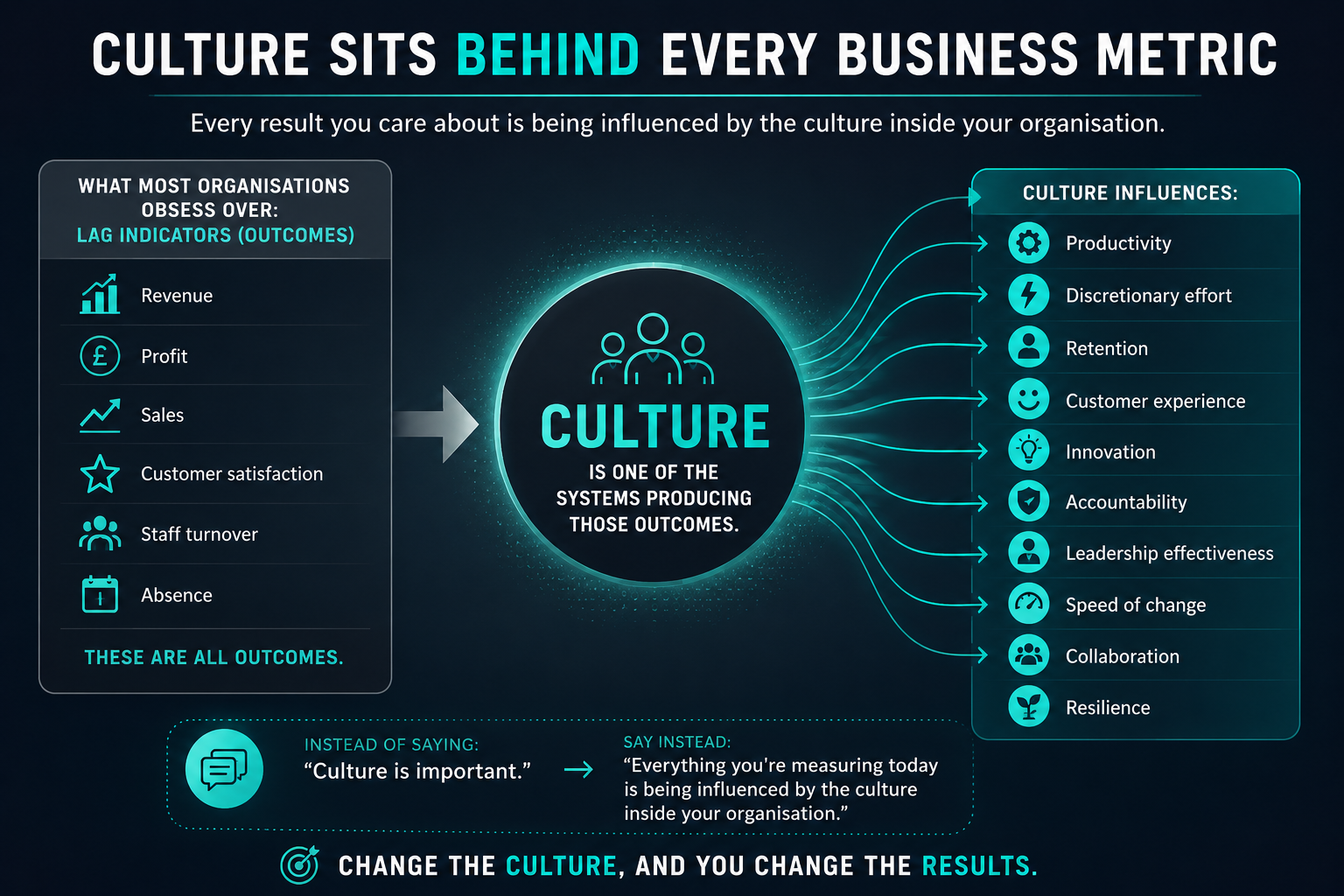
Most organisations obsess over lag indicators.
- Revenue.
- Profit.
- Sales.
- Customer satisfaction.
- Staff turnover.
- Absence.
These are all outcomes.
Culture is one of the systems producing those outcomes.
Instead of saying:
“Culture is important.”
Say:
“Everything you’re measuring today is being influenced by the culture inside your organisation.”
That is a completely different conversation.
Culture influences:
- productivity
- discretionary effort
- retention
- customer experience
- innovation
- accountability
- leadership effectiveness
- speed of change
- collaboration
- resilience
When leaders understand this connection, culture becomes commercially relevant.
Rule Four: Make Culture Tangible
Many leaders dismiss culture because they believe it is vague.
Words like:
- engagement
- wellbeing
- belonging
- values
often sound abstract.
Replace abstraction with systems.
A useful explanation is:
Culture is simply the operating system behind how people behave every day.
Or:
Culture isn’t soft. It’s a management system.
Every system can be:
- measured
- improved
- maintained
That instantly makes culture feel manageable.
Rule Five: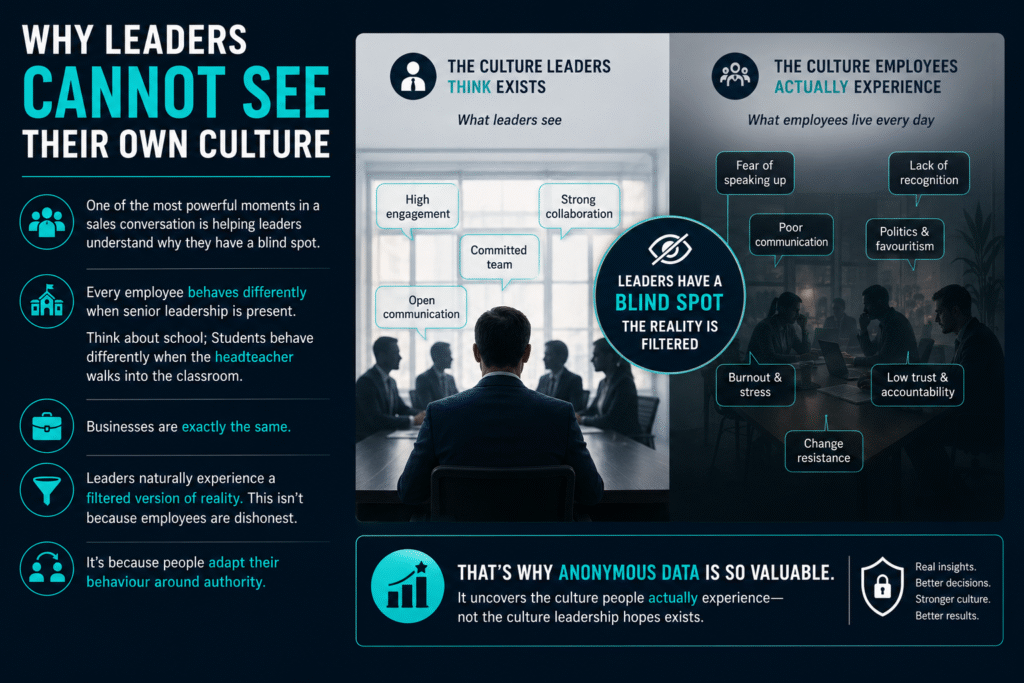 Explain Why Leaders Cannot See Their Own Culture
One of the most powerful moments in a sales conversation is helping leaders understand why they have a blind spot.
Every employee behaves differently when senior leadership is present.
Think about school; Students behave differently when the headteacher walks into the classroom.
Businesses are exactly the same.
Leaders naturally experience a filtered version of reality. This isn’t because employees are dishonest. It’s because people adapt their behaviour around authority.
That’s why anonymous data is so valuable.
It uncovers the culture people actually experience—not the culture leadership hopes exists.
Rule Six: Link Culture to Money
Business leaders understand financial impact.
So talk about financial impact.
Examples include:
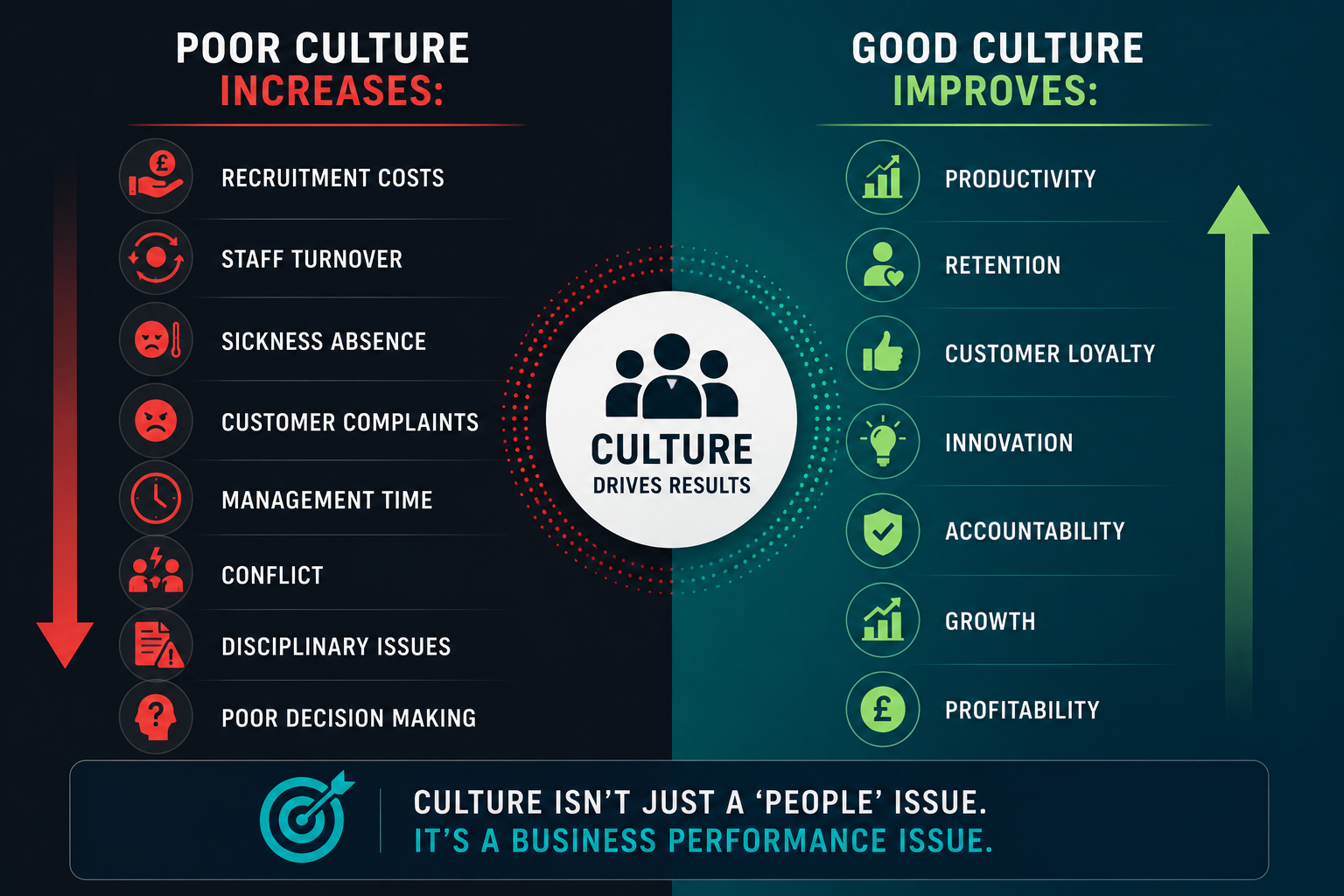
Poor culture increases:
- recruitment costs
- staff turnover
- sickness absence
- customer complaints
- management time
- conflict
- disciplinary issues
- poor decision making
Good culture improves:
- productivity
- retention
- customer loyalty
- innovation
- accountability
- growth
- profitability
The discussion moves from:
“Culture feels nice.” to “Culture affects financial performance.”
Rule Seven: Position Culture as a Competitive Advantage
Don’t present culture as fixing problems. Present it as creating performance.
A great culture helps organisations:
- grow faster
- execute strategy better
- retain talented people
- attract stronger candidates
- adapt to change
- develop better leaders
- outperform competitors
The strongest organisations don’t treat culture as an HR initiative. They treat it as business infrastructure.
Rule Eight: Simplify the Message
Many consultants unintentionally make culture sound complicated.
Avoid overwhelming prospects with:
- survey methodology
- response scales
- benchmarking models
- report structures
- assessment mechanics
Instead, use simple language.
A message such as:
Quick to deploy. Powerful to act on. Designed to improve business performance.
is far stronger than explaining twenty pages of methodology.
Remember:
People buy clarity. Not complexity.
Rule Nine: Sell the Future
Clients don’t buy reports. They buy certainty.
Help them imagine what success looks like.
For example:
Within four weeks you’ll have a clear understanding of what’s helping—or holding back—your organisation.
Explain what they’ll gain:
- honest employee insight
- evidence instead of assumptions
- prioritised actions
- leadership clarity
- measurable improvement opportunities
- expert support
Focus on the destination. Not the journey.
Rule Ten: Make Every Benefit Relevant
Never list generic benefits.
Always connect them to what the client told you earlier.
If they mentioned recruitment:
This will help identify the cultural factors affecting retention.
If they mentioned growth:
This will show whether your culture is enabling or restricting growth.
If they mentioned leadership:
This will identify where leadership behaviours are helping—or limiting—performance.
People don’t buy features. They buy solutions to their own problems.
A Simple Sales Framework
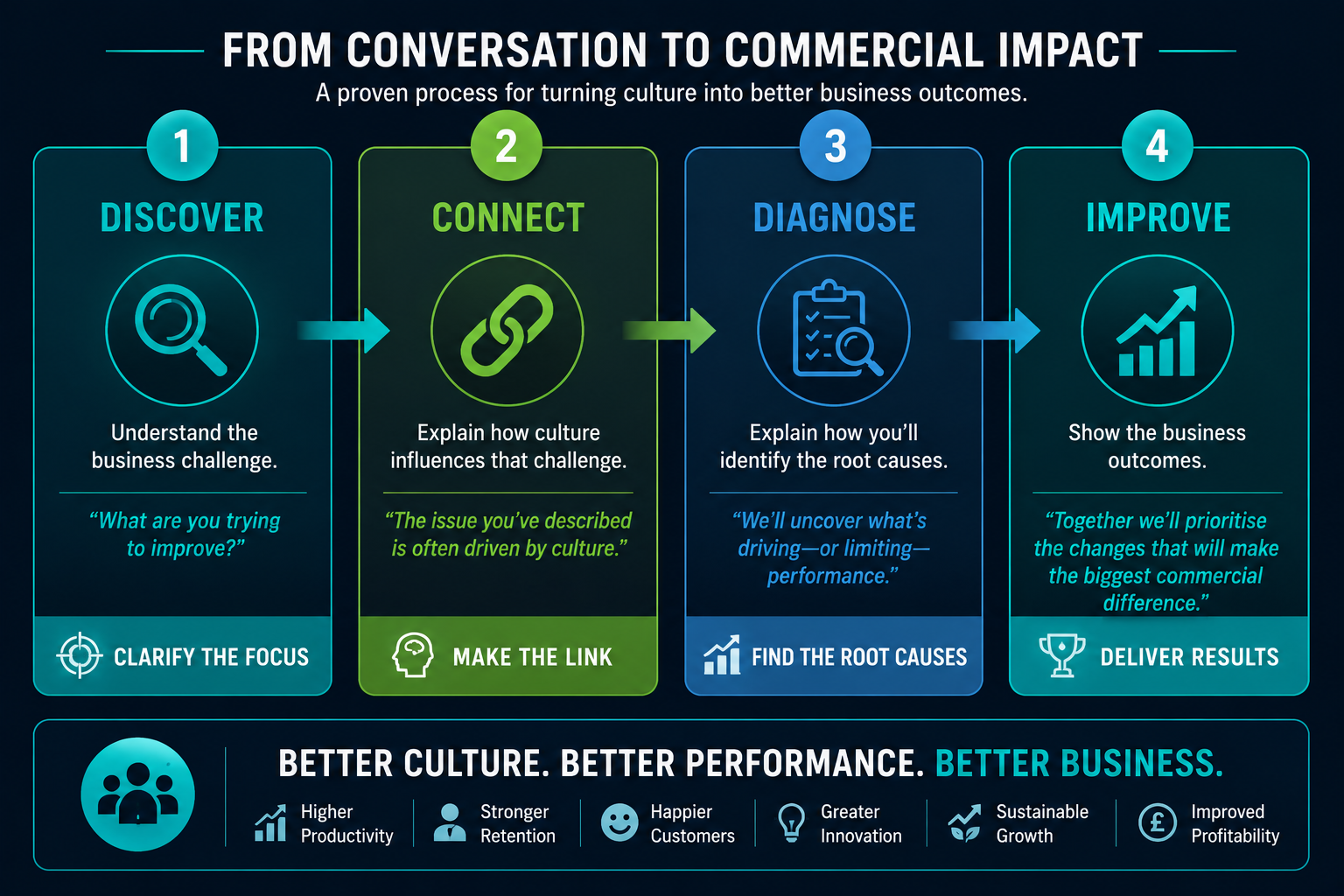
A useful conversation structure looks like this:
1. Discover
Understand the business challenge.
“What are you trying to improve?”
2. Connect
Explain how culture influences that challenge.
“The issue you’ve described is often driven by culture.”
3. Diagnose
Explain how you’ll identify the root causes.
“We’ll uncover what’s driving—or limiting—performance.”
4. Improve
Show the business outcomes.
“Together we’ll prioritise the changes that will make the biggest commercial difference.”
Questions Every Consultant Should Ask
Instead of asking:
“Would you like a culture survey?”
Ask:
- What’s stopping the business performing at the level you’d like?
- Where do you lose the most time?
- Which people issues consume the most leadership energy?
- If you could fix one thing tomorrow, what would it be?
- Where are your biggest frustrations?
- How confident are you that leadership sees the same organisation your employees experience?
- What would improving culture allow the business to achieve?
The Golden Rule
Never sell culture. Sell what culture improves.
Because business leaders don’t invest in surveys. They invest in stronger organisations.
Culture simply happens to be one of the most powerful ways to build one 🙌