

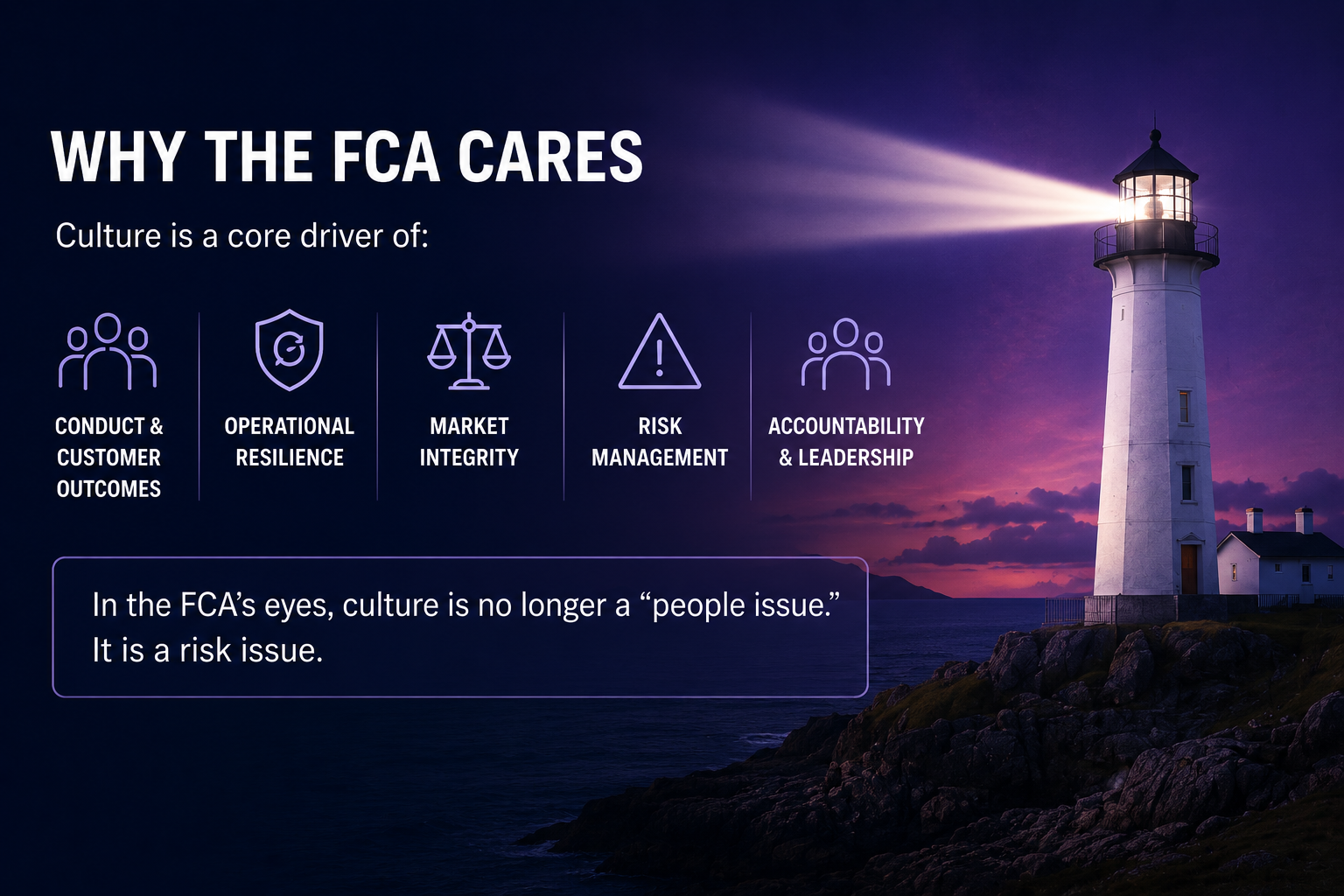
For years, organisational culture in financial services was treated as something intangible – important for employee engagement perhaps, but difficult to define, measure, or regulate. That has changed. Today, the Financial Conduct Authority (FCA) increasingly views culture as a core driver of conduct, customer outcomes, operational resilience, and market integrity. In the regulator’s eyes, culture is no longer a “people issue.” It is a risk issue.
And the reason is simple:
Organisations do not fail solely because policies are weak. They fail because behaviours, incentives, and leadership decisions drift away from stated values.
The FCA has learned – particularly in the aftermath of the 2008 financial crisis and subsequent conduct scandals – that misconduct rarely begins with a breach of policy. It begins much earlier, when organisational norms quietly tolerate behaviours that contradict the values printed on walls, websites, and annual reports. That is why regulators are increasingly focused on whether people within financial services organisations consistently act in line with the organisation’s stated values and behaviours. Not because values statements matter. But because behavioural consistency does.
Why Culture Matters More Than Ever
Financial services organisations operate in environments filled with complexity, pressure, commercial tension, and ethical grey areas. Policies cannot anticipate every scenario. Controls cannot monitor every interaction. At some point, organisations rely on human judgement. Culture is what shapes that judgement.
It determines:
- How people behave under pressure
- Whether concerns are escalated or hidden
- Whether customer interests are protected or deprioritised
- Whether leaders reward integrity or only outcomes
- Whether employees feel psychologically safe enough to challenge poor decisions
In practice, culture becomes the operating system of decision-making. That is why the FCA increasingly treats culture as a leading indicator of risk.
When there is a gap between what a firm says it values are, and how people actually behave, the regulator sees this as an early warning sign of deeper problems:
- Weak governance
- Poor leadership alignment
- Unhealthy incentives
- Ineffective controls
- Increased likelihood of customer harm
The Shift from “Paper Compliance” to Behavioural Evidence
Historically, many firms approached culture through policies, training modules, and corporate messaging. But regulators have become increasingly sceptical of what might be called “paper compliance.”
A firm can:
- Publish values
- Run mandatory training
- Launch culture campaigns
- Report strong employee engagement scores,
all while still creating environments where misconduct flourishes.
The FCA is therefore moving away from assessing:
- Whether policies exist
- Whether training was completed
- Whether values were communicated
and toward assessing:
- How decisions are made
- How leaders behave
- What behaviours are rewarded
- How issues are escalated
- What outcomes customers actually experience
This shift has accelerated under Consumer Duty and the Senior Managers and Certification Regime (SM&CR), both of which place far greater emphasis on accountability, conduct, and outcomes.
The message from the regulator is increasingly clear:
Culture is not what an organisation says. Culture is what an organisation consistently tolerates, rewards, and reinforces.
Why So Many Firms Still Get Culture Wrong
Despite increased regulatory focus, many firms continue to struggle with culture because they misunderstand what should actually be measured.
Most organisations still focus heavily on:
- Employee engagement
- Sentiment
- Awareness of values
- Participation in culture initiatives
But these metrics often reveal very little about behavioural risk.
A workforce can be highly engaged and still produce harmful customer outcomes. People may understand the values perfectly — and still behave contrary to them when commercial pressure intensifies.
This is where many organisations fail, they measure perception rather than behaviour, they assess intent rather than consistency and they monitor outcomes only after harm has already occurred.
As a result, firms often rely too heavily on lagging indicators such as:
- Complaints
- Disciplinary cases
- Whistleblowing events
- Confirmed conduct breaches
But by the time these appear, cultural weaknesses are already deeply embedded.
The FCA increasingly expects firms to identify behavioural risk earlier — before misconduct escalates into customer harm or regulatory intervention.
The Importance of Measuring Culture Properly
One of the biggest challenges organisations face is that culture is often discussed extensively but measured poorly. Many firms rely on annual engagement surveys that provide broad sentiment but very little behavioural insight. Others rely on anecdotal observations, leadership intuition, or isolated HR metrics. The problem is that culture cannot be effectively managed if it cannot be objectively assessed. And increasingly, regulators expect firms to move beyond subjective narratives and demonstrate credible evidence of behavioural alignment.
Effective culture assessment requires organisations to understand:
- Whether behaviours align to stated values
- Where behavioural inconsistencies exist
- How pressure impacts decision-making
- How leadership behaviours influence teams
- Where psychological safety is weak
- Whether incentives reinforce the right outcomes
Most importantly, organisations need the ability to identify cultural risks before they manifest as customer harm, regulatory breaches, or reputational damage. This is where many firms still have a significant blind spot, as they collect large volumes of data but struggle to connect values, behaviours, leadership actions, conduct risk and customer outcomes into one coherent picture. Without that visibility, culture remains reactive rather than proactive.
Leadership’s Blind Spot on Culture
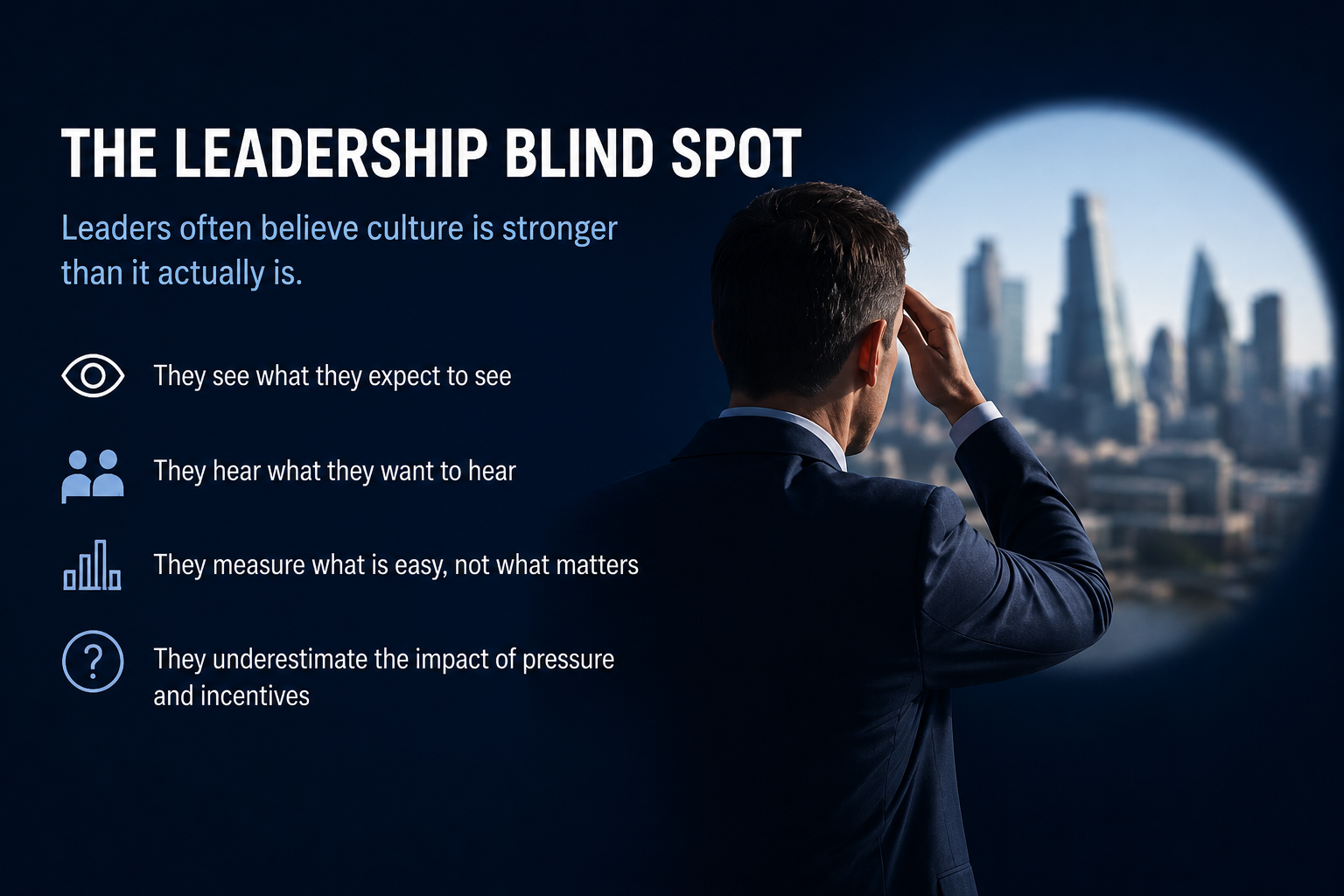
Perhaps the most difficult challenge is that many leadership teams significantly overestimate the health of their culture. There are several reasons for this.
1. Senior leaders experience the organisation differently
Executives often operate furthest away from frontline pressure, they may hear:
- Filtered information
- Curated reporting
- Sanitised narratives
Meanwhile, frontline employees experience:
- Conflicting priorities
- Commercial pressure
- Fear of escalation
- Inconsistent management behaviours
This creates a dangerous perception gap between leadership intent and organisational reality.
2. Leaders confuse communication with adoption
Many organisations believe culture is being embedded because leaders regularly communicate values. But communication alone does not create behavioural change.
The real test is whether:
- Managers reinforce values consistently
- Incentives align to behaviours
- Difficult decisions reflect stated principles
- Employees experience fairness and accountability
Culture is not embedded when people can repeat the values. It is embedded when behaviours remain consistent under pressure.
3. Leadership teams often rely on overly positive metrics
Traditional culture indicators frequently produce reassuring results:
- High engagement scores
- Low whistleblowing activity
- Strong training completion
- Positive survey sentiment
But these can create false confidence.
For example:
- Low whistleblowing may indicate fear rather than trust
- Strong engagement may coexist with excessive pressure
- Training completion reveals very little about behavioural adoption
Without deeper behavioural insight, leadership teams can miss emerging risks entirely.
4. Middle management is often overlooked
Many organisations focus heavily on “tone from the top.” But the lived culture of an organisation is usually determined by:
- Line managers
- Team leaders
- Local incentives
- Day-to-day behavioural reinforcement
In many firms, senior leadership messaging sounds healthy while middle-management behaviours unintentionally contradict it. Employees pay far more attention to what gets rewarded, what gets ignored and what happens to people who challenge decisions, than they do to executive presentations.
Why Measuring Culture Has Become a Strategic Necessity
Culture assessment is no longer simply about employee engagement or organisational development. It has become a strategic requirement for regulatory confidence, risk management, operational resilience, leadership accountability and long-term organisational sustainability.
The organisations best positioned for the future will be those that can evidence behavioural consistency, alignment between values and incentives, psychological safety, effective leadership behaviours and clear links between culture and customer outcomes. The Cultiv8tiv Financial Services Assessment is designed for use in regulated firms. Whether you are a growing advisory firm, lender, insurer, wealth manager or larger regulated organisation, our assessments provide practical insight to support stronger leadership, healthier working environments and cultures that align with FCA expectations.