

The Hidden Asset Buyers Are Beginning to Value
Every private equity investment has one objective: create a more valuable business.
Revenue growth matters. EBITDA growth matters. Cash generation matters.
But none of these, on their own, answer the question every buyer is really asking:
“Can this business continue to perform after the ownership changes?”
That question is becoming increasingly important in today’s market.
Financial performance demonstrates what a company has achieved. Organisational culture provides evidence that those results are repeatable.
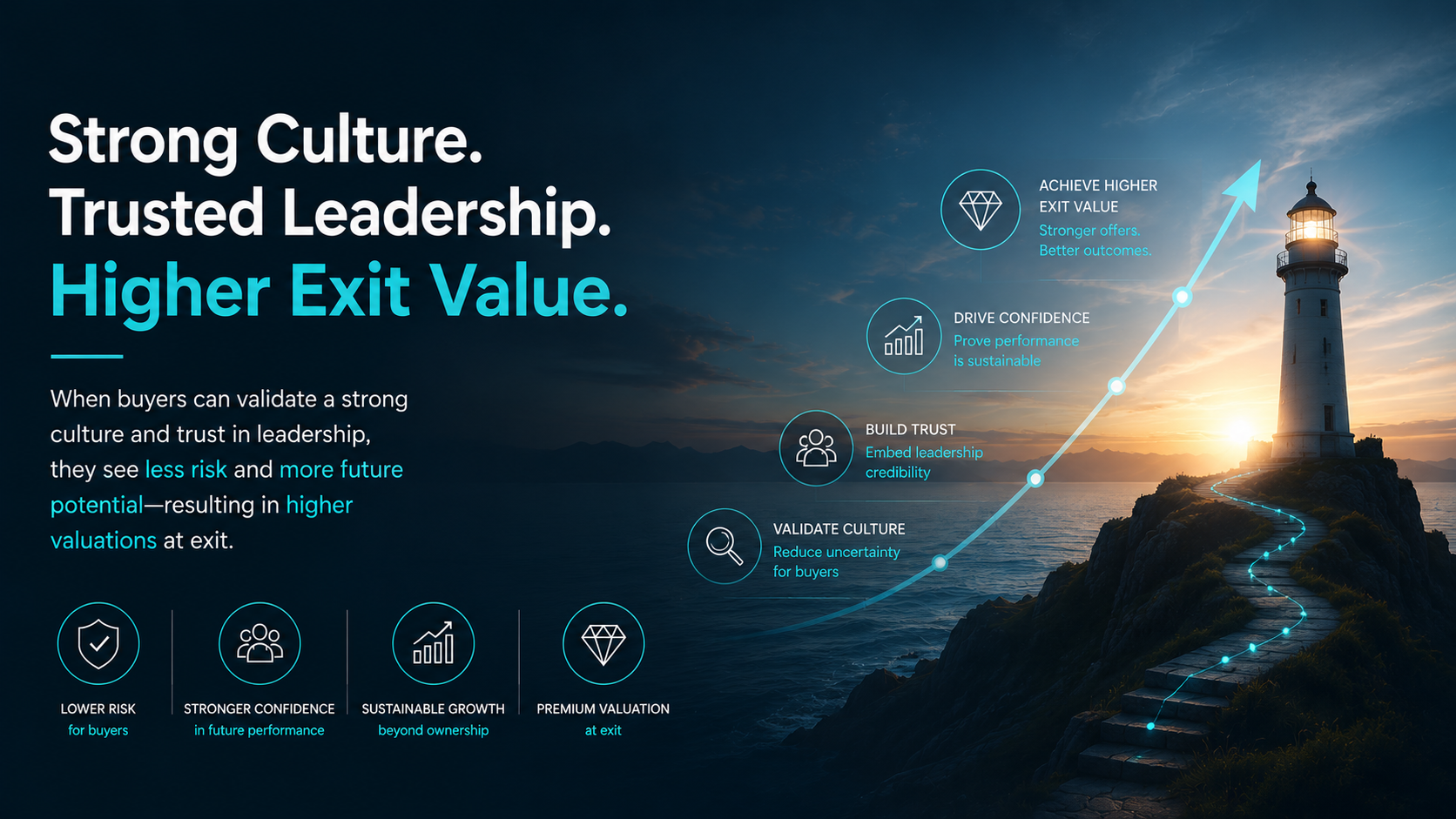
A business that can demonstrate a healthy, high-performing culture is often perceived as a lower-risk investment. Lower perceived risk supports stronger valuations, greater buyer confidence and, ultimately, a more successful exit.
Buyers Don’t Just Buy Financial Performance
Whether the acquirer is another private equity firm, a strategic purchaser or an institutional investor, they are buying future cash flows, not historic accounts.
They need confidence that:
- leadership capability extends beyond one or two individuals
- employees will remain after the transaction
- customers will continue to receive consistent service
- the business can continue executing its strategy
- future growth is sustainable
- operational improvements will continue
These aren’t purely financial questions. They are questions about organisational capability.
And organisational capability is largely determined by culture.
Trust in Leadership Is a Commercial Asset
One of the strongest indicators of future business performance is the level of trust employees have in their leadership.
Where trust is high, organisations typically experience:
- faster decision-making
- stronger accountability
- better collaboration
- higher engagement
- greater innovation
- lower staff turnover
- greater resilience during change
Perhaps most importantly, employees continue to perform even when ownership changes.
That significantly reduces transition risk for buyers.
Conversely, businesses where performance depends heavily on a charismatic founder or a small number of senior leaders often attract additional scrutiny.
If leadership trust has not been embedded across the organisation, buyers may question whether performance is sustainable.
Culture Makes Earnings More Credible
During due diligence, buyers spend considerable time validating financial information.
Increasingly, they also seek evidence that earnings quality is sustainable.
Questions such as these are becoming more common:
- Why is employee turnover so low?
- Why do customers remain loyal?
- Why has productivity continued to improve?
- Why have acquisitions integrated successfully?
- Why has innovation remained consistent?
The answer often lies in organisational culture.
When culture is measured rather than assumed, businesses can provide objective evidence that strong performance is supported by healthy organisational behaviours rather than exceptional circumstances.
That gives buyers confidence that future earnings are less dependent on luck, individual personalities or temporary market conditions.
Culture Reduces Perceived Risk
Valuation is not simply determined by financial performance. It is also influenced by risk.
Valuable businesses can demonstrate:
- stable leadership
- high employee engagement
- strong accountability
- effective communication
- clear decision-making
- high levels of trust
An organisation with the above characteristics are generally viewed as more resilient organisations.
Resilient organisations are easier to acquire, easier to integrate and more likely to maintain performance after completion.
Every uncertainty removed from the transaction can improve buyer confidence.
Measuring Culture Creates a New Due Diligence Asset
Historically, organisational culture has been discussed in subjective terms.
“It feels like a good place to work.”
“We have a great team.”
“Our people are engaged.”
These statements carry little weight during a transaction.
Today’s assessment technology allows organisations to measure culture with evidence.
Companies can demonstrate:
- leadership credibility
- trust across the organisation
- behavioural consistency
- alignment with strategic objectives
- employee confidence
- cultural strengths and potential risks
Instead of relying on opinion, sellers can provide data.
That transforms culture from an intangible concept into a measurable business asset.
Preparing for Exit Should Include Cultural Due Diligence
Many organisations spend months preparing financial records before a sale.
Operational processes are documented.
Governance is strengthened.
Legal risks are addressed.
Yet relatively few businesses assess one of the most important indicators of future performance: organisational culture.
Understanding culture before a transaction enables leadership teams to identify weaknesses, strengthen trust, improve execution and demonstrate organisational maturity long before buyers enter the data room.
This creates a stronger investment proposition.
The Businesses That Command Premium Valuations
The highest-valued businesses rarely succeed because they simply generate impressive numbers.
They inspire confidence.
Confidence that performance is repeatable.
Confidence that leadership is trusted.
Confidence that talented people will remain.
Confidence that customers will stay loyal.
Confidence that the organisation can continue to grow.
Strong financial performance tells buyers what the business has done.
A measurable organisational culture tells buyers what the business is capable of doing next.
That distinction can become one of the most valuable assets any organisation brings to market.
Because when buyers have confidence in both the numbers and the people behind them, they are no longer investing solely in historical performance.
They are investing in future potential. A strong and healthy culture is more guaranteed to deliver that future potential.