

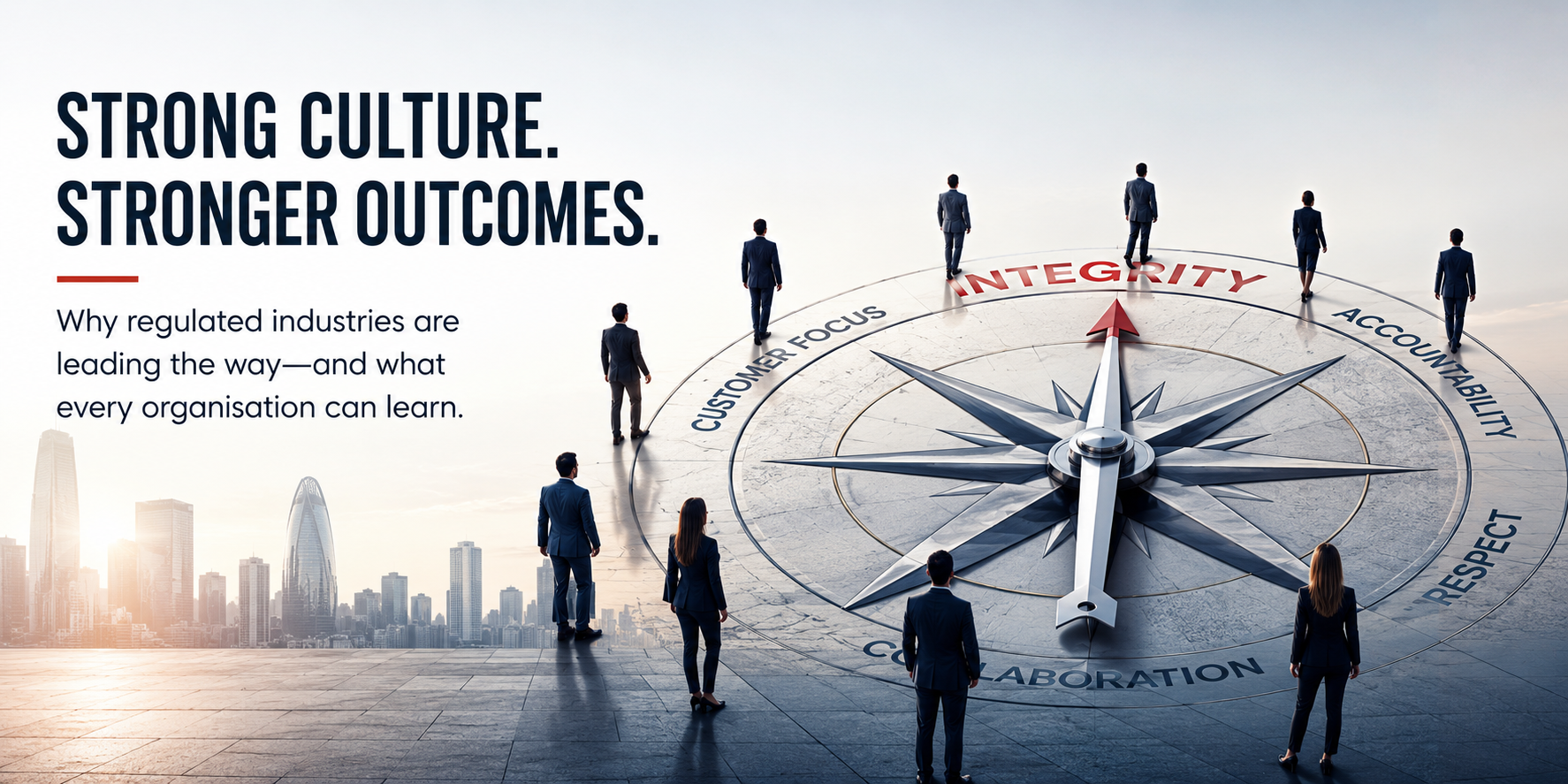
For many years, organisational culture was often treated as a secondary business concern, something linked primarily to employee engagement, internal communications, or workplace morale.
Today, that perception is changing rapidly.
Across highly regulated industries, culture is increasingly viewed as a critical driver of risk, performance, accountability, customer outcomes, and long-term sustainability. In sectors such as financial services, healthcare, aviation, energy, and pharmaceuticals, regulators and leadership teams now recognise that organisational failures rarely happen because policies are missing.
More often, failures occur because behaviours, incentives, leadership decisions, and day-to-day actions drift away from the organisation’s stated values.
This is one of the key reasons why regulators such as the UK Financial Conduct Authority (FCA) have placed such significant emphasis on culture in recent years.
But while the regulatory spotlight may currently shine brightest on financial services, the underlying lessons are relevant to every CEO, HR Director, and leadership team, regardless of sector.
Because culture is no longer simply a “people issue.”
It is increasingly a business-critical issue.
Why Regulators Like the FCA Are Focused on Culture
The FCA’s focus on organisational culture did not emerge in isolation.
It is the result of years of observing how major organisational failures unfold.
From the 2008 financial crisis to repeated conduct scandals across global banking and financial institutions, regulators recognised a recurring pattern:
Misconduct rarely begins with a deliberate breach of policy.
Instead, it often develops gradually within environments where:
- pressure outweighs ethics,
- incentives reward short-term outcomes over sustainable behaviour,
- employees feel unable to challenge decisions,
- leadership messages are inconsistent,
- or problematic behaviours become normalised.
The FCA increasingly understands that written policies alone cannot prevent these issues.
Organisations can have:
- extensive compliance frameworks,
- mandatory training programmes,
- detailed governance structures,
- and clearly articulated corporate values,
while still creating conditions where harmful behaviours flourish.
This is why the regulator now looks beyond “paper compliance” and focuses more heavily on behavioural evidence.
Increasingly, the FCA wants firms to demonstrate:
- how decisions are made,
- how leaders behave under pressure,
- how accountability is reinforced,
- whether employees feel psychologically safe,
- how customer outcomes are prioritised,
- and whether incentives genuinely align with stated values.
The introduction of frameworks such as the Senior Managers and Certification Regime (SM&CR) and Consumer Duty has accelerated this shift by placing far greater emphasis on accountability, conduct, and outcomes.
The message is clear:
Culture is not defined by what an organisation says.
It is defined by what an organisation consistently rewards, tolerates, and reinforces.
Why Regulated Industries Are Ahead of the Curve
Highly regulated industries are often forced to confront cultural issues earlier than other sectors because the consequences of failure are more immediate and visible.
In financial services, poor culture can lead to:
- customer harm,
- regulatory sanctions,
- operational failures,
- reputational damage,
- and significant financial penalties.
In healthcare, cultural failures can directly impact patient safety.
In aviation, they can affect operational reliability and risk management.
In energy and manufacturing, culture can influence safety outcomes, environmental risk, and crisis response.
As a result, many regulated industries have begun recognising something other sectors are only now starting to understand:
Culture directly influences organisational resilience.
It shapes how people make decisions when policies cannot anticipate every situation.
It determines whether issues are escalated or hidden.
It influences whether teams collaborate effectively under pressure.
And ultimately, it affects whether organisations remain aligned to their values during periods of commercial tension, uncertainty, or rapid growth.
In many ways, regulated industries have become an early warning system for the wider business world.
The same cultural weaknesses that create regulatory risk in financial services can also create:
- ethical failures,
- talent attrition,
- leadership breakdown,
- poor customer experience,
- reputational damage,
- and operational underperformance
in virtually every sector.
The Growing Realisation: Culture Drives Performance
One of the biggest shifts taking place across executive leadership teams is the recognition that culture is not separate from performance.
It drives performance.
For years, organisations often viewed culture as something intangible and difficult to measure.
But modern organisations increasingly recognise that culture influences:
- decision-making quality,
- employee accountability,
- collaboration,
- innovation,
- adaptability,
- customer trust,
- leadership credibility,
- and long-term business sustainability.
In reality, culture becomes the operating system behind organisational behaviour.
It determines how people respond when under pressure.
And pressure is where culture reveals itself most clearly.
An organisation’s true culture is rarely visible in corporate messaging or leadership presentations.
It becomes visible when:
- targets are missed,
- difficult decisions must be made,
- mistakes occur,
- teams are stretched,
- or commercial priorities conflict with ethical considerations.
That is when people discover whether values genuinely guide behaviour — or whether performance is prioritised at any cost.
Why Many Organisations Still Get Culture Wrong
Despite increased attention on culture, many organisations continue to misunderstand what should actually be measured.
Too often, culture is assessed primarily through:
- employee engagement surveys,
- sentiment analysis,
- values awareness,
- training completion,
- or participation in internal initiatives.
While these measures can provide useful information, they rarely offer a reliable picture of behavioural risk or organisational alignment.
An organisation can have:
- highly engaged employees,
- positive survey results,
- and strong participation rates,
while still experiencing:
- toxic leadership behaviours,
- unhealthy pressure,
- poor decision-making,
- low psychological safety,
- or harmful customer outcomes.
This is one of the biggest lessons regulated industries have learned.
Culture cannot be understood through communication alone.
It must be understood through behaviour.
The organisations making the greatest progress are those moving beyond perception-based metrics and focusing instead on:
- behavioural consistency,
- leadership alignment,
- incentive structures,
- decision-making patterns,
- accountability,
- and psychological safety.
Increasingly, leadership teams need visibility into whether behaviours across the organisation genuinely align with the values they promote.
The Incentive Problem: Where Culture Is Truly Revealed
Perhaps the clearest indicator of an organisation’s real culture is how success is rewarded.
This is where many businesses unintentionally undermine their own values.
Organisations often communicate commitments to:
- integrity,
- collaboration,
- customer focus,
- inclusion,
- and ethical leadership,
while simultaneously rewarding:
- short-term revenue generation,
- aggressive target achievement,
- excessive workload tolerance,
- or results achieved regardless of behaviour.
Employees quickly learn which behaviours truly matter.
And when high performers are protected despite toxic conduct, organisations unintentionally send a powerful message:
Results matter more than values.
This credibility gap is one of the biggest cultural risks organisations face.
Because culture is not shaped primarily by what leaders communicate.
It is shaped by:
- incentives,
- consequences,
- leadership behaviour,
- and the decisions organisations make under pressure.
Leadership’s Biggest Blind Spot
One of the most common cultural challenges across organisations is that leadership teams often overestimate the health of their culture.
There are several reasons why this happens.
1. Leaders experience the organisation differently
Senior executives are often furthest removed from frontline pressures.
They typically receive:
- filtered reporting,
- summarised feedback,
- and curated narratives.
Meanwhile, frontline employees may experience:
- conflicting priorities,
- pressure-driven decision-making,
- inconsistent management behaviour,
- or fear around escalation.
This creates a significant gap between leadership perception and organisational reality.
2. Communication is mistaken for cultural adoption
Many organisations assume culture is being embedded because leaders regularly communicate values.
But communication alone rarely changes behaviour.
The real test is whether:
- managers reinforce expectations consistently,
- incentives align with values,
- accountability is applied fairly,
- and employees experience behavioural consistency across the organisation.
Culture is not embedded when employees can recite the values.
It is embedded when behaviours remain aligned to those values under pressure.
3. Traditional culture metrics can create false confidence
Many leadership teams rely heavily on metrics such as:
- engagement scores,
- training completion,
- retention statistics,
- or low whistleblowing activity.
But these indicators can sometimes hide deeper problems.
For example:
- low whistleblowing may indicate fear rather than trust,
- high engagement may coexist with burnout,
- and training completion reveals little about behavioural adoption.
Without deeper behavioural insight, organisations often identify cultural problems only after they become visible through:
- customer complaints,
- reputational damage,
- regulatory intervention,
- leadership crises,
- or operational failures.
4. Middle management is often overlooked
While organisations focus heavily on “tone from the top,” lived culture is often shaped far more by:
- line managers,
- local leadership behaviours,
- team dynamics,
- and day-to-day reinforcement.
Employees pay closer attention to:
- what gets rewarded,
- what gets ignored,
- and how leaders react under pressure,
than they do to executive presentations or internal campaigns.
This is why cultural consistency across all leadership levels matters so significantly.
Why CEOs and HR Directors Across Every Sector Should Care
Although regulated industries may currently be leading the conversation around culture, the strategic implications extend far beyond compliance.
For CEOs, culture increasingly influences:
- organisational resilience,
- leadership effectiveness,
- reputation,
- innovation,
- operational performance,
- customer trust,
- and long-term sustainability.
For HR Directors and People Leaders, culture has become central to:
- leadership development,
- retention,
- employee wellbeing,
- performance management,
- succession planning,
- and workforce trust.
In increasingly complex and fast-moving business environments, organisations can no longer rely solely on policies and governance structures to guide behaviour.
At some point, every organisation depends on human judgement.
Culture is what shapes that judgement.
And organisations that fail to understand their culture proactively often discover problems only after performance, trust, or reputation have already been damaged.
The Shift Towards Measuring Culture Properly
One of the most important developments emerging from regulated industries is the growing recognition that culture must become measurable.
Historically, culture has often been treated as subjective and difficult to quantify.
But organisations increasingly recognise that if culture influences behaviour, risk, and performance, then it must also be capable of being assessed more objectively.
This means moving beyond static engagement surveys and broad sentiment analysis toward deeper behavioural insight.
Leading organisations are beginning to focus more closely on:
- behavioural alignment,
- leadership consistency,
- psychological safety,
- decision-making under pressure,
- incentive structures,
- accountability patterns,
- and the relationship between culture and organisational outcomes.
The goal is not simply to measure whether employees feel positive.
It is to understand whether organisational behaviours consistently support sustainable performance and healthy decision-making.
Culture Is Becoming a Strategic Business Priority
The organisations best positioned for the future will not necessarily be those with the most polished values statements.
They will be the organisations that can demonstrate:
- alignment between values and behaviours,
- consistency between leadership messaging and leadership action,
- psychologically safe environments,
- healthy accountability,
- and clear links between culture, decision-making, and organisational outcomes.
This is why regulated industries are leading the conversation.
Not because they are uniquely interested in culture.
But because they have experienced the consequences of getting it wrong.
And increasingly, organisations across every sector are realising the same thing:
Culture is not a soft issue.
It is one of the clearest predictors of organisational resilience, leadership credibility, customer trust, and long-term success.
As regulatory expectations, employee expectations, and stakeholder scrutiny continue to evolve, culture is likely to become one of the defining leadership priorities of the next decade.
The organisations that understand this earliest, and measure it most effectively, will have a significant advantage.