

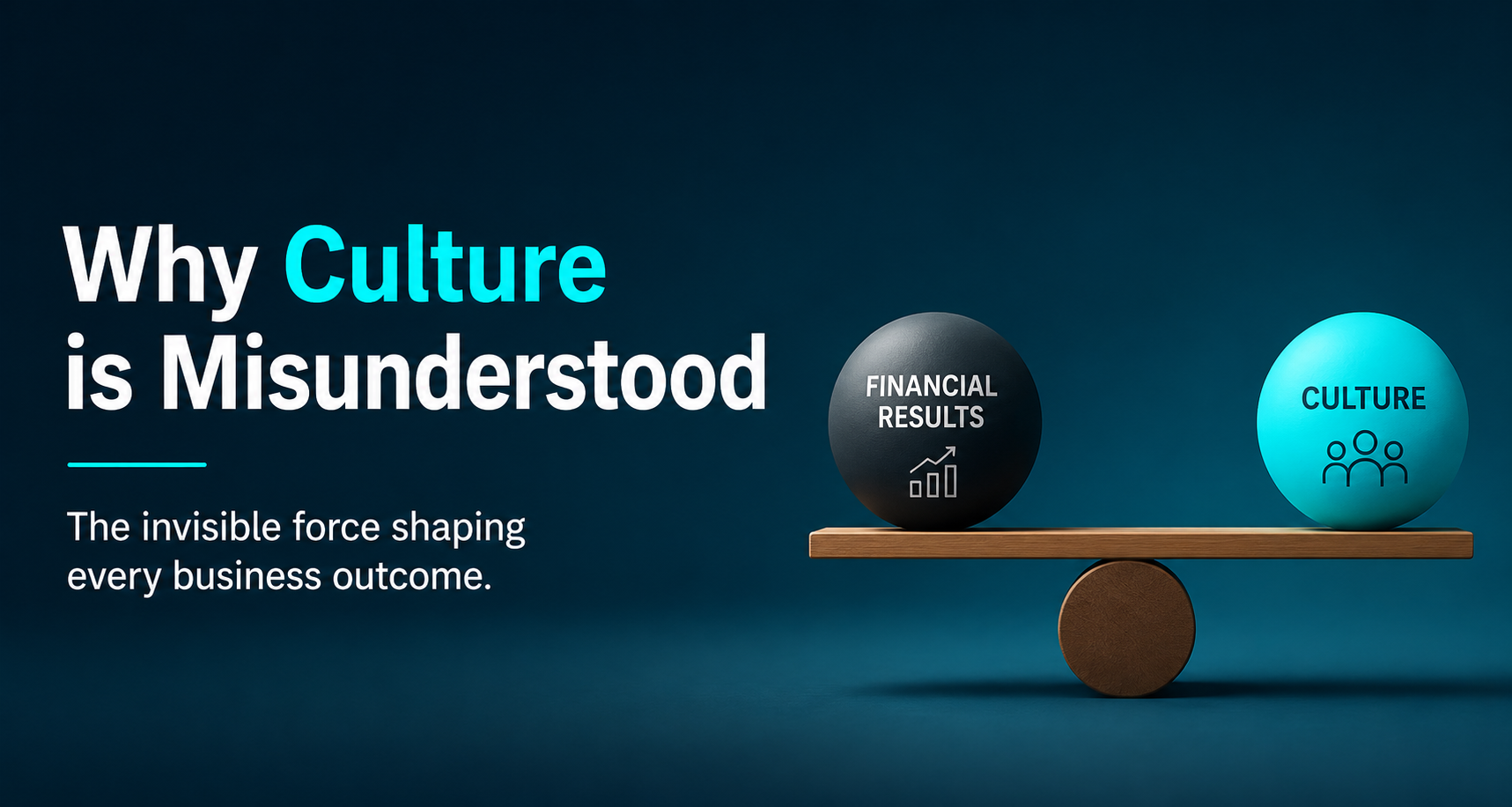
Culture influences how people communicate, make decisions, respond to pressure and deliver on an organisation’s strategy. Yet it remains one of the most widely misunderstood concepts in business. In this insight, Cultiv8tiv CEO and Founder James Leavesley explores why leaders can mistake the visible signs of a positive workplace for culture itself, how authority can obscure the reality employees experience and why a meaningful culture assessment must look beyond stated values to the behaviours shaping everyday work.
Every CEO I meet can tell me their revenue. Most know their EBITDA, and they can explain customer acquisition costs, gross margins, sales pipeline, employee turnover, productivity metrics and cash flow without hesitation. These are the measures that make their way into reports, guide investment decisions and shape conversations about organisational performance.
Then I ask a much simpler question: “Tell me about your organisational culture.” The answers almost always begin in a similar place. I hear that they have a really good team, that people seem happy, that the business has invested heavily in wellbeing or that the company values have recently been refreshed. None of these are wrong answers, but they are answering a different question. They describe some of the things an organisation offers or hopes to represent, rather than explaining how its culture actually works.
The reality is that, despite decades of research demonstrating the impact of culture on organisational performance, many leaders still treat it as intangible, subjective or “soft”. It may be considered important, but it is also seen as difficult to define and even harder to measure. The irony is that organisational culture is already influencing every commercial outcome those leaders care about. The challenge is not that they do not value culture. It is that they are often looking for it in the wrong places.
The great misunderstanding: visible culture versus lived behaviour
One reason culture is so difficult to grasp is that organisations frequently confuse visible artefacts with the underlying behaviours that determine how work gets done. Ask people what workplace culture means and they will often point to free coffee, modern offices, wellbeing initiatives, flexible working, company values displayed on walls, social events or a general sense of employee happiness. All of these things can contribute to a positive working environment, and they may reflect good intentions, but they are not the culture itself. They are expressions of it.
That distinction matters because an organisation can provide unlimited snacks, beautiful offices, generous benefits and inspirational values painted across every meeting room while still having an unhealthy culture. If employees are afraid to challenge poor decisions, reluctant to admit mistakes or unwilling to speak honestly with leadership, the visible investment has not changed the experience beneath it. Conversely, an organisation with modest facilities can develop an exceptional culture when people trust one another, hold each other accountable and feel psychologically safe enough to raise concerns before they become serious problems.
A useful culture assessment therefore has to go beyond the most visible parts of the employee experience. It needs to examine whether the behaviours people encounter each day support or contradict what the organisation claims to value. Culture is not ultimately defined by what an organisation says about itself. It is defined by what its people consistently experience. I think of it as the invisible operating system that governs behaviour when nobody is watching.
Organisational culture lives in behaviour
Every organisation develops unwritten rules, whether its leaders intend to create them or not. Employees quickly learn whether challenging a leader is likely to limit their career, whether mistakes will be treated as opportunities to learn or evidence of failure, and whether collaboration is genuinely rewarded or quietly discouraged. They also learn whether difficult conversations are addressed or avoided, and whether accountability applies consistently or changes according to a person’s seniority.
These rules do not appear in the employee handbook and they are rarely explained during an induction. Nevertheless, people understand them because they observe what happens around them. They notice which behaviours are recognised, which concerns are ignored, who is allowed to make mistakes and what happens to somebody who speaks openly. Those repeated experiences become the organisation’s real culture, not necessarily because leadership designed them, but because behaviour spreads far more effectively than policy.
People do not follow mission statements in isolation. They follow what gets rewarded, tolerated and repeated. This is why a culture assessment should explore the patterns behind individual experiences rather than relying only on whether employees say they are happy. It can help an organisation understand whether its formal values are being reinforced through everyday leadership and decision-making, or whether a different set of unwritten rules is shaping behaviour in practice.
Why leaders experience a different organisation
Perhaps the greatest obstacle to understanding organisational culture is something remarkably human: people behave differently around authority. Every leader has experienced the way a room can change when the CEO walks in. Conversations become more cautious, problems seem smaller, confidence appears greater and agreement comes more easily. This does not necessarily reflect dishonesty. It reflects the fact that employees naturally assess the personal risk involved before they speak openly.
Someone considering whether to raise an issue may quietly ask whether doing so will make them appear negative, whether disagreeing could affect their progression, whether it would be safer to remain silent or whether anyone else shares the same concern. Even when leaders genuinely invite challenge, employees make decisions based on what they have seen happen previously, not only on what they are told is welcome.
The result is predictable. People protect themselves, problems remain hidden, difficult conversations are postponed and feedback becomes increasingly filtered as it moves through the organisation. Over time, leaders can begin to experience a version of the business that differs significantly from the one experienced by everybody else. Senior leadership may genuinely believe communication is open, while employees genuinely believe leadership does not listen. Both perspectives can be authentic because the two groups are observing different realities.
An objective culture assessment helps make that gap visible. It gives leaders a way to compare intention with employee experience and identify where trust, communication or psychological safety may be changing what people feel able to say. Without that broader evidence, a leader may understandably assume that the conversations taking place in their presence represent the conversations happening throughout the organisation.
The commercial cost of filtered information
This disconnect has profound consequences because, by the time an issue becomes visible to the executive team, it has often been visible to frontline employees for months and sometimes years. The warning signs were present, but people did not feel able or sufficiently motivated to raise them through the organisation. In other cases, they may have tried to speak up but learned from the response that continuing to do so was unlikely to change anything.
We see the effects repeatedly across organisations. Customer service can deteriorate long before leadership notices a pattern. High performers may quietly disengage before eventually resigning. Innovation slows when people stop offering ideas because suggestions are routinely ignored, and managers become overloaded when nobody feels able to challenge unrealistic expectations. Each outcome may initially appear to be an isolated operational issue, but together they can reveal a deeper behavioural pattern.
Eventually, something measurable changes. Employee turnover increases, absence rises, productivity falls, customer complaints escalate or financial performance weakens. Leadership responds because these are visible business measures, but the response often focuses on the symptom rather than the cultural cause beneath it. Recruitment activity may address a vacancy, a productivity initiative may target output and a new customer process may respond to complaints, while the lack of trust, openness or accountability that contributed to the problem remains untouched.
This is one reason culture measurement matters commercially. A well-designed culture assessment can help leaders see patterns before their consequences become another line in a performance report. It does not replace commercial metrics. It adds context that can explain why those metrics are moving and where action may be needed before performance deteriorates further.
Why culture rarely appears in board papers
There is another reason organisational culture is consistently underestimated: executives are trained to manage what they can measure. Every month, they receive structured reports on revenue, profit, costs, productivity, sales performance, cash flow and forecasts. These measures are visible, routinely discussed and connected to decisions about investment, accountability and future priorities.
Culture rarely receives the same treatment, not because it lacks importance, but because it has historically been difficult to quantify. As a result, it often enters the boardroom only after a problem has emerged. The conversation may be prompted by unexpected resignations, poor engagement survey results, a regulatory failure, rising customer complaints, a merger that never fully integrates or a period of rapid growth that suddenly becomes difficult to manage.
In other words, organisations measure the consequences of culture rather than culture itself. They see the effect once it appears in turnover, customer experience, risk or financial performance, but they may not have had a clear view of the behavioural conditions developing beforehand. A structured culture assessment gives leaders evidence they can discuss alongside other organisational measures. It brings greater clarity to areas such as trust, accountability, leadership behaviour, communication and psychological safety, making culture more accessible as a strategic business issue rather than an abstract concern.
The behavioural foundations nobody sees
I often compare culture to the foundations of a building. Nobody admires the foundations when they visit. They notice the architecture, the windows, the design and the impressive exterior, but every structural engineer knows that the foundations determine what can safely be built above them. If those foundations begin to weaken, cracks eventually appear. The change is rarely immediate. It develops gradually and can remain almost imperceptible until the damage becomes visible in the walls.
Organisational culture works in much the same way. Revenue, productivity, innovation, retention and customer experience all sit on top of behavioural foundations. When those foundations are strengthened by trust, open communication, clear accountability and consistent leadership behaviour, they create resilience. When they are weak, they create fragility, even if the organisation’s visible performance still appears healthy.
The metrics that leaders can see are often reflecting what is happening underneath. A culture assessment is valuable because it helps an organisation examine those foundations directly, rather than waiting for a visible crack to confirm that something has gone wrong. It provides a clearer view of the conditions supporting performance and the areas where the organisation may be more vulnerable than its headline results suggest.
Why intuition is not a substitute for a culture assessment
Many experienced leaders pride themselves on having a strong feel for their organisation, and often that instinct is well founded. They know their people, understand the history of the business and can recognise when something does not feel right. But intuition has limits, particularly as an organisation grows and senior leaders become further removed from the day-to-day employee experience.
More management layers emerge, information becomes increasingly filtered and it becomes harder for any one person to see how culture differs across teams, roles or levels of seniority. Success can also create confidence, and confidence can sometimes create blind spots. No leader deliberately chooses to lose touch with organisational reality. Distance simply makes that reality harder to see, which is why relying solely on instinct becomes increasingly risky.
Few organisations would consider managing their finances without financial reports, their customer experience without customer feedback or their operations without performance data. Yet many still attempt to manage organisational culture primarily through assumptions and occasional anecdotal feedback. A culture assessment adds the evidence that intuition alone cannot provide. It can test whether leadership’s perception is shared across the workforce and reveal where experiences differ within the same organisation.
The future of evidence-led leadership
The organisations that gain a competitive advantage over the next decade will not necessarily be those with the largest budgets or the newest technology. They will be the organisations that understand their people with the same precision with which they understand finance. This is not because culture replaces commercial performance. It is because culture creates the conditions in which commercial performance is achieved.
When leaders gain objective insight into behavioural patterns, levels of trust, the quality of communication, accountability and psychological safety, conversations about culture become far more strategic. Instead of stopping at the broad question of whether people are engaged, leaders can ask where employees are struggling to speak openly, which teams demonstrate the strongest leadership behaviours and where trust begins to break down. They can examine which behaviours are accelerating performance and which are quietly undermining it, even when the impact has not yet appeared in headline metrics.
These questions lead to more focused action because they direct attention towards the behaviours and experiences an organisation can influence. Action creates behavioural change, and behavioural change drives organisational performance. Used in this way, a culture assessment is not separate from business strategy. It helps leaders understand whether the way people actually work will support the strategy they are asking the organisation to deliver.
Organisational culture is no longer a soft issue
For years, culture was viewed as something for HR to look after. Today, boards, regulators, investors and executive teams increasingly recognise that it has much wider consequences. Culture determines how decisions are made and risks are managed. It influences how customers are treated, whether new ideas are welcomed and how effectively a strategy moves from an executive plan into everyday action.
Ultimately, organisational culture helps determine whether a business can deliver sustainable performance consistently or whether it will quietly drift into decline despite having talented people and an ambitious strategy. The organisations that thrive are not necessarily those with the loudest values statements or the largest wellbeing budgets. They are the ones prepared to understand the gap between intention and reality.
That gap is fundamental to any honest culture assessment because culture is not defined by what leaders hope is happening. It is defined by what employees experience every day. Stated values matter only when people can see those values reflected in leadership behaviour, organisational decisions and the way colleagues treat one another when work becomes difficult.
Measuring the culture you actually have
The irony is that culture has never been more important, yet it has rarely been less understood. Leaders measure almost everything that matters to the business, while the factor influencing every other metric can remain largely invisible. It is time to stop treating organisational culture as something intangible and start treating it as what it has always been: the operating system of every organisation.
Like any operating system, culture affects how every part of the organisation functions. If leaders do not understand what is happening within it, they should not be surprised when performance begins to fail. The question is not whether culture affects the business, because it already does. The more important question is whether leaders are measuring the culture they believe they have or the culture their people actually experience.
A meaningful culture assessment provides a way to answer that question with evidence rather than assumption. By examining the behaviours behind trust, accountability, communication, leadership and psychological safety, organisations can see more clearly what is supporting performance, what is placing it at risk and where focused action is needed.
Get in touch to find out how a Cultiv8tiv culture assessment can help you understand your organisation’s culture and decide what to do next.