

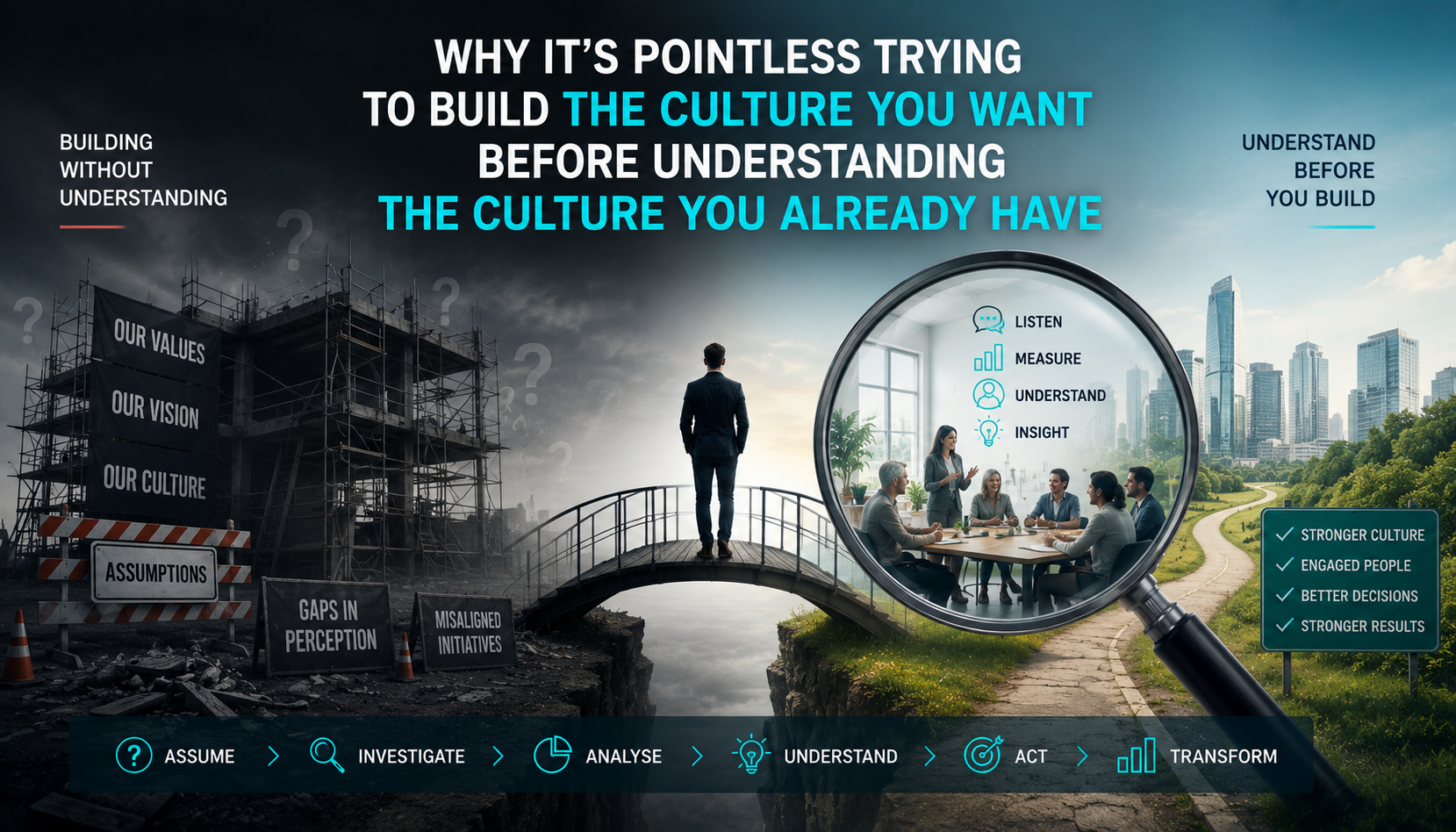
Every organisation wants a great culture. Very few understand the one they already have.
Spend five minutes on LinkedIn and you’ll find countless articles explaining how to build a high-performing culture.
You’ll read about defining your values, creating a compelling vision, improving engagement, empowering employees, developing leaders and recognising success.
All of these things have value.
But they all assume one thing;
That you already understand the culture you’re trying to change.
Unfortunately, many organisations don’t.
Instead, they begin with aspiration rather than evidence. They invest time and money creating the culture they hope people experience, without first understanding the culture employees actually live every day.
It’s rather like redesigning a building without surveying its foundations.
The plans might look impressive. But if the foundations are weak, the building won’t stand.
Culture works exactly the same way.
Before you can shape the future, you have to understand the present.
Culture Isn’t What You Say It Is
One of the biggest misconceptions in business is that culture is defined by values.
Ask a leadership team to describe their culture and you’ll often hear words such as:
- Collaborative
- Innovative
- Inclusive
- Respectful
- Customer-focused
- High-performing
- People-first
These are admirable aspirations.
But aspirations are not measurements.
Your values describe the organisation you want to become.
They don’t necessarily describe the organisation your employees experience.
- Culture isn’t the poster in reception.
- It isn’t the words on your website.
- It isn’t what appears in your recruitment brochure.
Culture is what happens every day when nobody is watching.
- It’s how people make decisions.
- How managers behave under pressure.
- Whether people feel safe speaking up.
- Whether mistakes become opportunities to learn or reasons to blame.
- Whether collaboration is encouraged or quietly discouraged.
- Whether accountability exists across every level of the organisation or only when something goes wrong.
Culture exists whether leaders choose to define it or not.
Every Organisation Already Has a Culture
Whether intentional or accidental.
Healthy or unhealthy.
Consistent or fragmented.
Every organisation develops patterns of behaviour over time.
People learn what gets rewarded.
They learn what gets ignored.
They learn who is listened to.
They learn how conflict is handled.
They learn whether honesty is welcomed or punished.
Eventually these unwritten rules become stronger than any written policy.
This is why two organisations can have identical values displayed on their walls but completely different employee experiences.
One organisation genuinely empowers its people.
Another simply talks about empowerment while decisions remain tightly controlled.
The values may be identical. The culture is not.
The Cost of Assuming You Already Know
Perhaps the biggest mistake organisations make is believing they already understand their culture.
Leadership teams often rely on instinct.
“We’ve got a good feel for what’s happening.”
“Our engagement scores are improving.”
“Our people seem happy.”
“We have an open-door policy.”
The problem is that leadership experiences culture differently from everyone else.
Senior leaders generally enjoy:
- Greater autonomy
- Better communication
- More visibility
- More influence
- Stronger relationships
- Faster access to information
Their daily experience is fundamentally different from someone working on the shop floor, serving customers, managing projects or leading frontline teams.
This creates what we call the Leadership Perception Gap.
The difference between how leaders believe the organisation operates and how employees actually experience it.
Sometimes the gap is small.
Sometimes it’s enormous.
The challenge is that leaders rarely know which until they measure it.
Employee Engagement Isn’t the Same as Organisational Culture
Many organisations believe they already measure culture because they conduct employee engagement surveys.
While engagement surveys provide useful information, they answer a different question.
Employee engagement tells you how people feel.
Culture helps explain why they feel that way.
An engaged employee may still work in an organisation with poor communication, inconsistent leadership or low trust.
Likewise, an employee experiencing temporary frustration may still work within a fundamentally healthy culture.
Engagement measures outcomes.
Culture measures the conditions that create those outcomes.
Understanding this distinction is critical.
Because if you only measure engagement, you’re often treating symptoms rather than identifying causes.
Why Guessing Is Expensive
Poor culture isn’t simply an HR issue.
It becomes a commercial issue remarkably quickly.
Research consistently links organisational culture with measurable business outcomes including:
- Employee retention
- Productivity
- Innovation
- Customer satisfaction
- Safety
- Leadership effectiveness
- Financial performance
- Organisational resilience
When culture weakens, these outcomes rarely decline overnight.
Instead they erode gradually.
Communication becomes slower.
Decision-making becomes inconsistent.
Managers begin avoiding difficult conversations.
Trust declines.
High performers quietly leave.
Customer experience suffers.
Innovation slows.
Revenue growth becomes harder.
By the time leadership notices the commercial impact, the cultural issues have often existed for years.
The Medical Analogy
Imagine visiting your GP and saying:
“I’d like to lower my blood pressure.”
No responsible doctor would immediately prescribe treatment.
They would first understand your current condition.
They would measure. Investigate. Diagnose.
Only then would they recommend treatment.
Business leaders accept this logic everywhere else.
Financial decisions begin with financial data.
Marketing decisions begin with customer insight.
Operational improvements begin with performance metrics.
Yet when it comes to culture, organisations frequently skip diagnosis altogether.
They move straight to solutions.
Without evidence.
Without measurement.
Without understanding.
What Should Organisations Actually Measure?
If culture is more than engagement, what should leaders be looking at?
The answer lies in understanding the conditions that influence organisational performance.
Questions such as:
- Do people trust leadership?
- Are managers creating psychological safety?
- Is accountability consistent?
- Do employees feel respected?
- Is communication open and honest?
- Are people empowered to make decisions?
- Do teams collaborate effectively?
- Do employees understand organisational purpose?
- Are leaders living the values they promote?
- How well does the organisation respond to change?
These factors collectively create the environment people experience every day.
They also determine whether strategic initiatives succeed or fail.
You Can’t Improve What You Don’t Understand
Imagine two organisations with exactly the same problem.
Employee turnover has increased.
Organisation A assumes salary is the issue.
Organisation B measures culture.
The results reveal that pay isn’t the problem.
Employees are leaving because they don’t trust their managers.
The solutions become entirely different.
Organisation A spends thousands increasing salaries.
Organisation B invests in leadership development.
One treats the symptom.
The other addresses the cause.
Measurement transforms assumptions into informed decisions.
Defining Your Future Culture Still Matters
None of this suggests organisations shouldn’t define their desired culture.
They absolutely should.
Vision matters.
Values matter.
Leadership behaviours matter.
But they become significantly more powerful once grounded in reality.
Knowing where you want to go is important.
Knowing where you’re starting from is essential.
Otherwise, your culture strategy becomes little more than wishful thinking.
Culture Should Be Managed Like Every Other Strategic Asset
Organisations routinely measure:
- Revenue
- Profit
- Customer satisfaction
- Productivity
- Operational performance
- Sales pipeline
- Marketing effectiveness
Why?
Because these metrics influence business performance.
Culture deserves exactly the same level of attention.
Not because it’s fashionable.
Not because it’s an HR initiative.
Because culture influences every one of those business metrics.
When organisations begin measuring culture objectively, they stop relying on opinions and start making evidence-based decisions.
The conversation changes.
Leadership discussions become more strategic.
Investment becomes more targeted.
Change becomes more effective.
From Assumption to Insight
One of the greatest risks facing organisations today isn’t having a poor culture.
It’s believing they understand their culture when they don’t.
Assumptions create blind spots.
Blind spots create poor decisions.
Poor decisions become expensive.
The organisations that outperform their competitors aren’t necessarily those with the most inspiring value statements.
They’re the ones willing to confront reality.
To ask difficult questions.
To listen objectively.
To understand what employees genuinely experience.
Only then can they decide what should change—and what should stay exactly as it is.
The Bottom Line
Before you redesign your values.
Before you launch another engagement initiative.
Before you commission leadership workshops.
Before you create another culture programme.
Ask one simple question:
“What evidence do we actually have that tells us what our culture is today?”
Because until you understand your current culture, every attempt to improve it is built on assumptions rather than insight.
And organisations don’t transform through assumptions.
They transform through understanding.
Because the best cultures aren’t created by guesswork.
They’re created by leaders who first have the courage to understand reality.