

An organisation-wide culture assessment gives leaders a valuable view of how employees experience the business. It can reveal strengths, highlight concerns and provide a clear starting point for improvement. Issues can arise though when this overall result hides significant differences between teams.
Employees in one department may feel supported by their manager, confident in raising concerns and clear about the organisation’s direction. Elsewhere, colleagues in another team may experience inconsistent communication, limited recognition or uncertainty about how their work contributes to wider goals. Both experiences contribute to the same overall score, yet each calls for a different response.
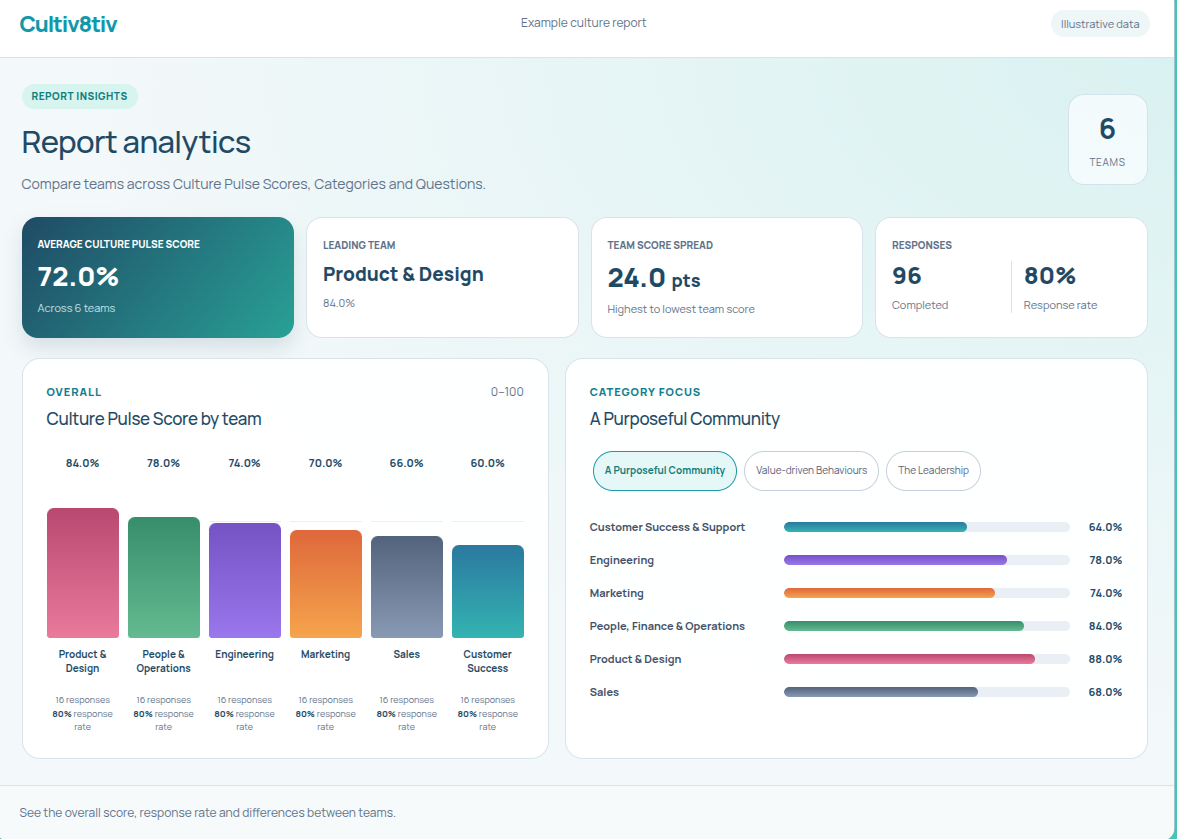
Cultiv8tiv’s new Team Analytics helps leaders understand these differences by bringing team-level results directly into our culture assessment platform. You can compare Culture Pulse Scores, explore responses across categories and questions, and review participation across teams, giving you a clearer picture of where to focus your attention.
Why team-level culture insight matters
An organisation may have a shared purpose and a consistent set of values, but employees experience culture through their everyday interactions. Their manager, workload, colleagues and access to information all influence how those values translate into practice.
This means a workplace culture assessment can show a broadly positive result while individual teams face challenges that deserve attention. Equally, an area identified as a concern across the organisation may be working well in a particular department.
Consider a business whose overall results suggest employees feel comfortable speaking up. Looking more closely at team-level responses could reveal that confidence is much stronger in some teams than others. Leaders can then investigate what is contributing to those differences and decide where further conversations or support would be useful.
Understanding that variation helps organisations make more informed decisions. It also creates an opportunity to learn from teams whose experiences are particularly positive, rather than treating culture improvement solely as a process of finding problems.
From manual survey analysis to insight within Cultiv8tiv
For many organisations, understanding culture by team involves a considerable amount of work after an engagement survey closes.
Someone needs to export the responses, separate them into groups, calculate scores and create charts. They may then repeat the process for each category or question before preparing findings for different managers and stakeholders.
Even when the underlying data is useful, this process takes time and requires care. Comparisons need to use the same calculations, groupings and presentation to remain meaningful. As the number of teams grows, so does the work involved in producing and checking each view.
Cultiv8tiv’s Team Analytics brings these comparisons into the assessment platform. Leaders can explore team results alongside the wider findings, reducing the need to build separate spreadsheets and reports before they can begin interpreting the results.
The benefit goes beyond saving administrative time. Having team comparisons available in one place makes it easier to explore differences, ask better questions and move from reviewing data to deciding what to do next.
What can you explore with Team Analytics?
Team Analytics adds another level of detail to your culture assessment, helping you connect the organisation-wide picture with the experiences of individual teams.
Compare Culture Pulse Scores across teams
See how overall culture scores vary across the organisation and identify where results differ most. This gives you a starting point for exploring both strengths and areas that may need closer attention. A score is an invitation to investigate further. Understanding the context behind it is essential before deciding on an intervention.
Explore specific categories and questions
An overall team score provides a useful summary, but the detail helps explain what may be shaping it. Comparing results across culture categories and individual questions can reveal whether a difference relates to leadership, communication, shared purpose or another aspect of the employee experience. This helps leaders focus their follow-up on the issues employees have actually identified.
Review participation alongside results
Response numbers and participation rates provide useful context when interpreting findings. A team with limited participation offers a different evidence base from one where most employees have responded. Bringing this information alongside culture results helps leaders judge where they have a clearer picture and where further engagement may be needed.
Make culture improvement more relevant to each team
When organisations only look at overall findings, it is easy to apply the same action plan everywhere. That approach can mean asking some teams to address issues they are not experiencing, while others need more focused support.
Team-level insight helps leaders tailor their response.
If one team’s results point to uncertainty about priorities, the next step might involve clearer planning and communication. If another reports weaker confidence in raising concerns, leaders may need to explore how challenge is received and how concerns are handled. Where results are strong, follow-up conversations can help identify practices that other teams could learn from.
This gives managers a more relevant starting point for discussion and helps organisations direct their time and resources towards the areas where support is most needed.
Use team comparisons to start better conversations
Team Analytics is most useful when it supports curiosity and constructive discussion. Differences between teams do not, on their own, explain why those differences exist.
A team may be navigating a restructure, managing a demanding workload or adjusting to new leadership. These circumstances matter when interpreting employee feedback.
The aim should be to understand employees’ experiences and identify practical ways to improve them. Comparisons work best as a starting point for thoughtful follow-up, with care taken to protect anonymity and avoid attributing feedback to individuals.
Used this way, team-level culture insight can help leaders have more focused conversations, support managers more effectively and build action plans grounded in evidence.
A clearer route from assessment to action
Understanding workplace culture requires both a broad view of the organisation and an appreciation of the differences within it.
Cultiv8tiv’s Team Analytics brings those perspectives together. By making team comparisons available within the culture assessment platform, it reduces the manual work involved in preparing results and helps leaders focus on what those results mean.
You can see where experiences differ, investigate the factors behind those differences and plan improvements that reflect the needs of each team.
Want to see how Team Analytics could support your next culture assessment? Get in touch to explore our platform and find a product suited to your needs.