

We recently spoke to a leadership team who were refreshingly honest. They knew their culture wasn’t great and they need to do something, but it felt overwhelming. So guess what they were inclined to do?
Do Nothing!
They decided to do nothing because they felt it was a little like opening Pandora’s box!! it’s an understandable reaction, but the wrong one for a whole host of reasons!
Waiting doesn’t keep things where they are
A poor culture doesn’t stand still while leaders decide when to tackle it. It drifts.
- Good people leave- is that what you want? Those with the most options are the quickest to use them.
- The people who stay just adapt. They learn to keep their heads down, avoid challenge and protect themselves.
- Productivity slowly erodes. Discretionary effort disappears so the work rate drops, people care less because they aren’t engaged.
- Bad habits harden into normalised behaviours. What was tolerated last year becomes “how things are done here”.
- Every month makes the next step harder. Trust that has worn thin takes longer to rebuild.
I can see why leaders become overwhelmed, because they think that everything has to be fixed at once. It doesn’t!
“At Cultiv8tiv we help you to understand the culture you have so you can build the culture you want”
By ignoring the fact that the culture needs fixing doesn’t mean that employees aren’t talking about. The fact is that when a culture is poor then employees will spend more time talking about it than talking about their actual roles.
Here are some simple steps that I took and part of the reason why I created Cultiv8tiv.
Step one: find out what you’re really dealing with
Knowing your culture is poor is not the same as knowing why. A vague sense that “things aren’t great” is exactly what makes thew whole thing feel overwhelming. If you don’t understand the reasons behind the issues then you can’t see what needs fixing.
Measuring your culture properly changes that. It shows you:
- Where the real issues sit, and where things are better than you feared.
- What your people say is getting in the way, in their own words.
- Which teams, functions or levels are struggling most, so effort goes where it matters.
- What’s already working, so you can protect it while you fix the rest.
A problem you can see clearly is a problem you can start to solve. That is why finding out is the first, and most important, step.
Step two: prioritise them
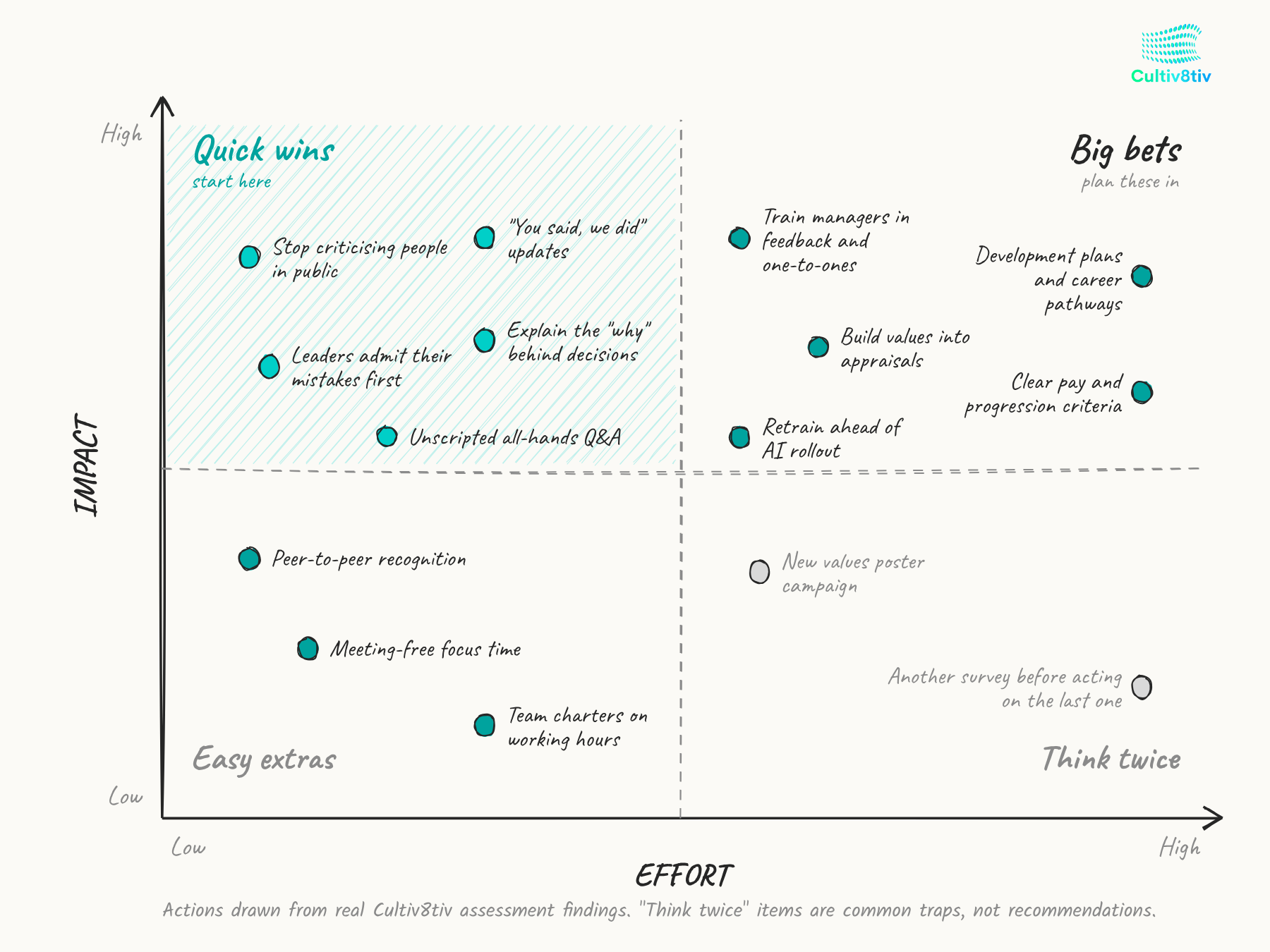
You might be left with a small list of issues or it may be a long one. Either way there needs to be a priority list and the easiest way to do this is to complete an effort<>impact assessment.
Plot the problems so you can see what will have the biggest impact and you might be surprised by how small some of those things are to fix
Step three: acknowledge it, out loud
Step three costs nothing, and it is one of the most powerful things a leadership team can do. Tell your people that you know things aren’t where they should be, that you’ve listened, and that you intend to act. Most employees already know the culture isn’t right so it won’t be a surprise, but it will extremely refreshing for them to hear it being acknowledged by a member of the leadership.
Step four: commit to change, then make it visible
Acknowledgement without action quickly turns to cynicism. So the commitment has to follow, and people need to see it.
You don’t have to change everything straight away. You do have to change something people will notice. Pick two or three priorities from your effort<>impact work and act on them. Now tell everyone what you did. The response to visible progress, however modest, is often far greater than leaders expect, because it proves that speaking up was worth it.
Great culture is built on the basics
There is no secret formula for a great culture. It comes from doing the basics well, consistently, over time.
At Cultiv8tiv we look at culture through 12 areas. Leaders don’t need to tackle all 12 at once. But each one has a basic that, done well, makes a noticeable difference:
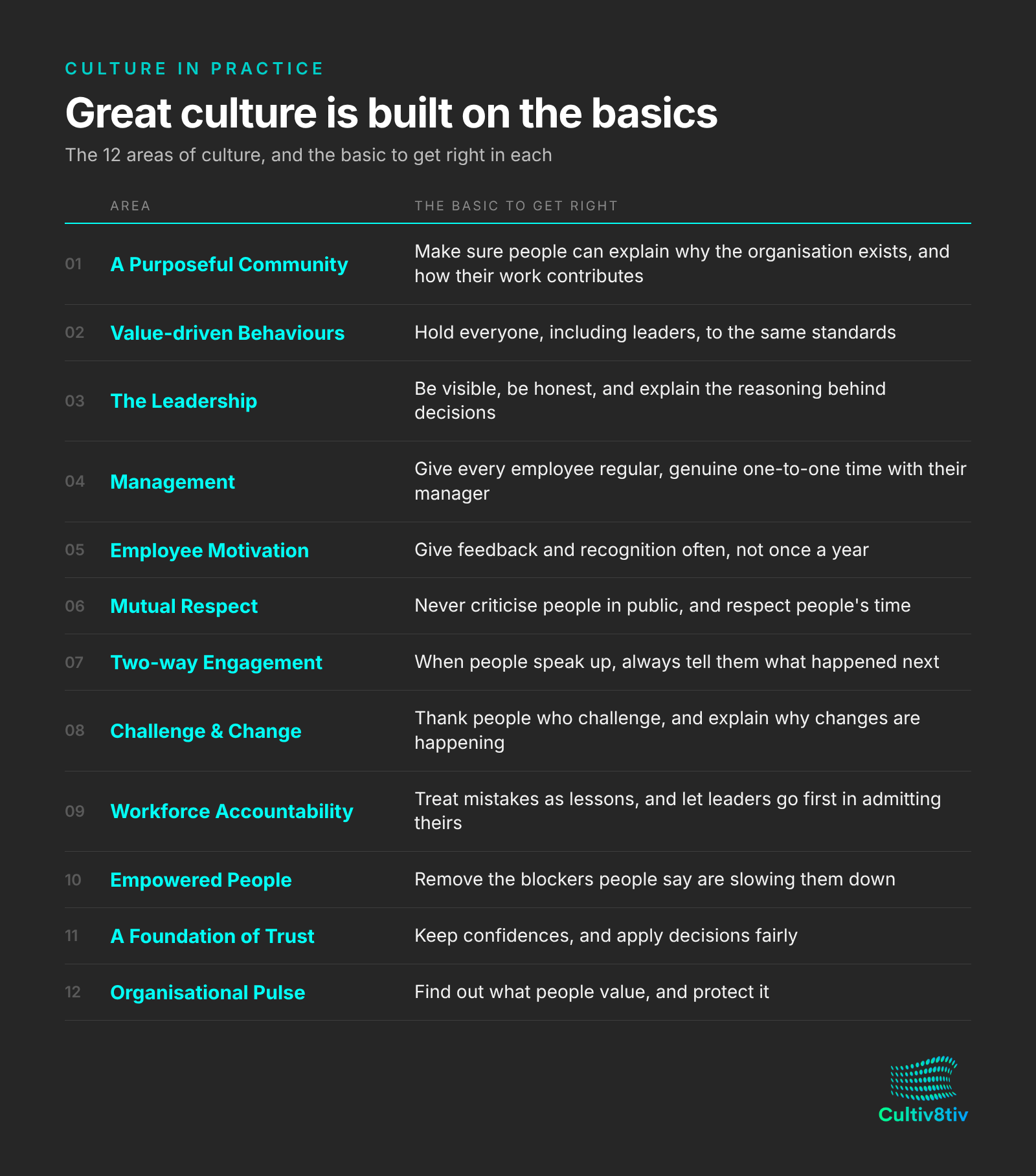
None of these needs a big budget or a transformation programme. Most need leaders to decide that they matter, and then to do them reliably.
A realistic first 90 days
- Find out. Measure your culture so you know where you really stand, and why.
- Acknowledge. Share what you found with your people, honestly, including the uncomfortable parts.
- Choose. Pick two or three areas from the 12 where a basic, done well, would make the biggest difference.
- Act visibly. Make changes people can see, and say clearly that they came from what employees told you.
- Report back. Tell people what has changed and what comes next.
- Check progress. Measure again, so you can see what has improved and choose the next priorities.
“Slow, steady steps are absolutely fine. Standing still is not.”
Signs you’ve started well
- People notice something has changed, and talk about it.
- More people are willing to speak up, because they’ve seen it make a difference.
- Leaders talk openly about culture, including what still isn’t right.
- The next assessment shows movement in the areas you chose to focus on.
You don’t fix a poor culture in one go. You fix it by deciding to start, and then by doing the basics well, one step at a time. Finding out where you really stand is the first and most important step, and that’s what Cultiv8tiv assessments are designed to do.
If you want to know more then please check out www.cultiv8tiv.com