

Introduction
In service-based businesses, culture is felt in every client conversation, every decision and whether people feel able to speak up. It shapes how employees experience work and how clients experience the service they receive.
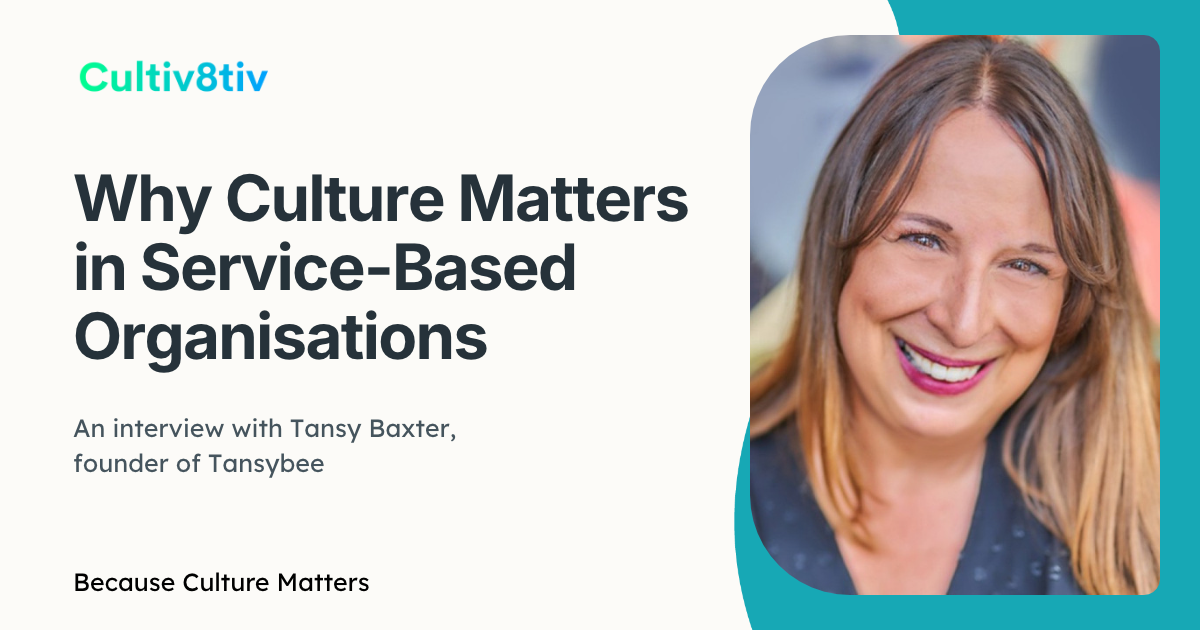
To explore those connections, our CEO and Founder, James Leavesley, spoke with Tansy Baxter, founder of Tansybee. Tansy works with service-based businesses, with a current focus on building societies and accountancy firms, helping leaders understand their culture and turn that insight into practical improvements.
In this interview, she explains why leadership teams can miss what is happening beneath the surface, how culture influences retention and client loyalty, and why objective, anonymous feedback creates a stronger starting point for change. Her message is clear: culture is something real that affects the bottom line.
1. You work with a wide range of service-based businesses. Why do you believe organisational culture is often the biggest differentiator between businesses that simply survive and those that genuinely thrive?
Organisational culture has a daily impact on the lives of the company’s employees. It affects how they feel about going to work, the job that they do and the company they work for.
When a company has a strong and positive culture, employees are more engaged, which increases productivity, improves customer service, reduces sickness absence and means that good people stay with the company for longer. It’s not just a ‘nice to have’ – it’s essential for business success.
2. Service organisations don’t sell products; they sell expertise, relationships and trust. How does culture directly influence the experience that clients ultimately receive?
When employees are engaged, it shows in the way they do their jobs, including how they deliver the customer experience.
For example, if the employees’ values are aligned with the company’s, it feels more natural for them to act in a way that supports those values. They’re not putting on an act; the employees are being true to themselves.
If they trust that the leadership team will listen to them if they raise any issues, and support them in trying to deliver great customer service, they will be more likely to speak up and make suggestions for improvements.
3. Many leaders believe they know what their culture is. In your experience, how often does perception differ from reality, and why do you think culture remains such a blind spot for leadership teams?
I think in most cases, the perception is different to the reality. It’s very difficult for leadership teams to truly gauge what their culture is because they often don’t get the full picture, especially where an organisation is hierarchical.
In these situations, people can become reticent to speak up if they feel something isn’t right or fair, fearing the consequences – whether those are real or imagined. It’s often said that an organisation’s culture is based on the worst behaviour that’s accepted, which is a scary thought!
Open and honest two-way communication is vital to closing the gap. Another way to tackle this is through frequent and timely values-based recognition that includes everyone. Because then it’s clear which behaviours you want to reinforce and be repeated.
4. Professional services firms often recruit highly skilled people. What role does culture play in attracting, engaging and retaining talented professionals when salary alone is no longer enough?
Culture reflects the perception and reputation of a company. You can have a great salary package and the ideal role for a person, with perfect progression opportunities, but unless your business is seen as an Employer of Choice or has an excellent reputation as being a great place to work, talented candidates will look elsewhere.
5. Many accountancy firms are competing for scarce talent while trying to strengthen client relationships. How can developing the right organisational culture help firms improve both employee retention and client loyalty?
Again, it’s all about how engaged the employees are and this is driven by having a positive workplace culture. Employees who are disengaged are 2.6 times more likely to leave their jobs and that can be expensive for businesses. The total cost of replacing someone who leaves can be around 50-100% of their salary.
For client loyalty, this is often based on how satisfied your clients are with the service they receive. And there is a direct correlation between improving employee engagement and an increase in customer satisfaction.
6. Across all of the organisations you’ve worked with, what are some of the early warning signs that suggest a culture is beginning to drift, even before performance starts to decline?
If good people are leaving or there are more sick days being taken than before, these are potential early warning signs. Line managers are often the first people to notice if something isn’t feeling right.
That’s why it’s so important for people to feel safe if they speak up – that they’ll be listened to and that action will be taken where possible. Because our surveys are anonymised and the company sees only the aggregated results, this means people are more likely to raise any concerns and be honest with their answers.
7. When organisations genuinely understand their culture through meaningful data, what kinds of conversations suddenly become possible that weren’t happening before?
It opens the door for open and honest conversations, without fear of repercussions. People making suggestions for improvements, as well as highlighting anything they’re uncomfortable with or unsure about. And also, celebrating when things go well.
These types of conversation help to build trust, meaning people feel heard and respected.
8. You recently became a Cultiv8tiv Partner. What attracted you to Cultiv8tiv, and why do you believe measuring culture objectively is such a valuable addition to the work you already do with clients?
As soon as we first spoke with each other, I knew that Cultiv8tiv was the right company for me to work with. Objectivity and anonymity are vital in measuring culture effectively and measuring where a company’s culture is right now is the first step in the journey to improvement.
Initially, I was intending to measure the culture by carrying out 1-2-1 interviews with a selection of employees, but when you explained the level of insight that was available through your platform and its AI module, I realised it would be more accurate, quicker and more cost effective.
Getting the results as actionable insights means I can use my time and experience better by creating a prioritised plan for businesses to improve their culture and keep their good people for longer.
9. If every leader truly understood one thing about culture, what would you want it to be?
That it isn’t a fluffy conceptual idea, but something real that has an impact on the bottom line.
Final Thoughts
Tansy’s answers connect culture with the everyday realities of running a service business: keeping good people, delivering consistent client experiences and making it safe to raise concerns. Understanding those experiences starts with listening. Objective, anonymous feedback gives leaders a clearer view of where they are now and a practical basis for deciding what needs to change.
About Tansybee
Founded by Tansy Baxter, Tansybee supports service-based businesses with workplace culture and employee engagement. With a current focus on building societies and accountancy firms, Tansy combines culture insight with a prioritised plan to help businesses improve how people experience work.